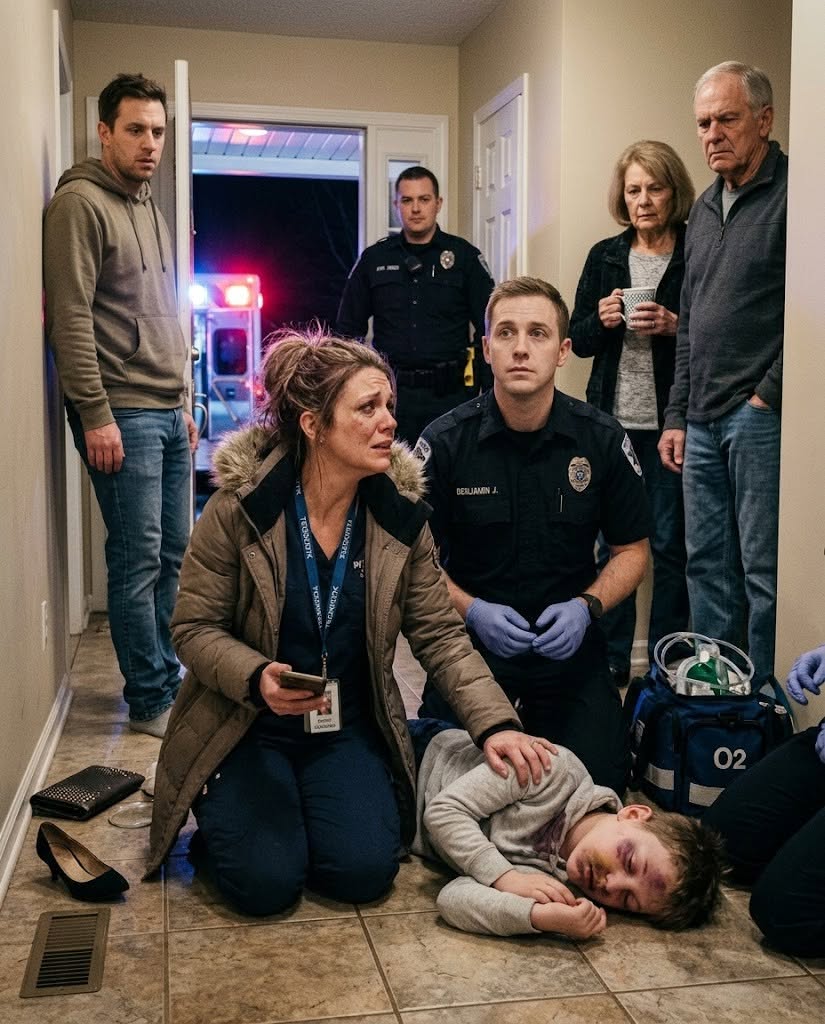
The paramedic’s name was Mateo Ruiz, and he kept his eyes on Ryan when he answered me.
“A boy called 911 at 8:17 and said his uncle had hurt him,” Mateo said.
“Your brother met us at the door, put a woman on speaker who claimed to be you, and refused transport.”
My mother’s coffee mug slipped half an inch in her hand.
Mateo noticed.
So did I.
“Was it her voice?” I asked.
Before he could answer, Ryan stepped between us and lowered his voice as though I were the person making the hallway unsafe.
“Hannah, Eli was awake when they came,” he said.
“He was talking, and your mother confirmed he didn’t need an ambulance.”
My mother nodded too quickly.
“We were protecting him from unnecessary stress.”
The police officer behind the paramedics moved closer.
Her nameplate read KLINE.
I bent, picked up the brass house key beside my cracked clutch, and closed my fist around it before Ryan could reach the floor.
“Officer, I was never called,” I said.
“I did not refuse treatment.”
Ryan glanced at our father.
It was small.
It was enough.
Officer Kline told everyone except the medical team to step away from Eli.
My father began explaining that Ryan had only corrected disrespectful behavior, but I talked over him and gave Kline the time I had left for the company party, the name of the hotel, and the names of three coworkers who had been beside me all evening.
While Mateo’s partner lifted Eli onto the stretcher, I showed Kline my phone.
There were no calls from the paramedics.
There was one missed call from my home phone at 8:12.
At 8:21, my mother had texted me.
Everything is fine here. Enjoy your night.
I handed the phone over without deleting the message.
Ryan’s face tightened.
“Think carefully,” my mother said.
“You’re exhausted, and Eli needs calm adults around him.”
I followed the stretcher outside.
The cold cut through my thin party dress, and one of the forgotten grocery bags had tipped over beside the driveway, leaving a jar of pasta sauce pressed against the wet concrete.
Ryan called my name from the doorway.
I did not turn around.
Inside the ambulance, Mateo secured a strap across Eli’s legs while I kept one palm against my son’s shin.
The heater was turned too high, and the foil wrapper from an alcohol pad trembled near Mateo’s boot whenever the vehicle moved.
“I should have pushed harder at 8:17,” he said.
I asked him to tell me everything in the order it happened.
According to Mateo, dispatch had received a whispering call from a child who said his uncle had grabbed his neck.
The caller gave my address, said his name was Eli, and then stopped speaking.
When the ambulance arrived, Ryan opened the door before they knocked.
He brought Eli into view but kept one hand on his shoulder.
Eli was standing then.
His face was pale, and Ryan said he had fallen while running through the hallway.
When Mateo asked to speak with a parent, Ryan called someone and put her on speaker.
The woman identified herself as Hannah Mercer.
She said Eli became dramatic when corrected, insisted I was at dinner nearby, and refused transport.
Mateo had asked Eli whether he felt safe.
Ryan squeezed his shoulder.
Eli said yes.
Then Ryan shut the door.
Mateo rubbed his thumb along the zipper of his medical bag as he spoke.
“He told dispatch he was ten,” he added.
I watched Eli’s chest rise under the oxygen mask and did not correct him.
At the hospital, a trauma team took Eli through double doors while a nurse stopped me at a desk with a clipboard.
The emergency department smelled like burnt coffee, and a paper snowflake had been taped upside down beside the admissions window.
I wrote my name where she pointed.
My hand shook only once.
Officer Kline arrived while I was still answering questions about allergies and medications.
She had separated Ryan and my parents, and she wanted to know who had been responsible for Eli that evening.
“My mother,” I said.
I opened our text thread and found the message she had sent two days earlier.
I’ll stay at your place with Eli from six until you get home. Don’t worry about anything.
Ryan had not been invited.
My father had not been invited.
Kline photographed the message, then asked whether Ryan had a key.
“He shouldn’t.”
The brass key was still cutting into my palm.
I opened my fingers and saw a red groove across my skin.
“That’s the spare from the kitchen drawer,” I said.
“My key has a blue cap.”
The key in my hand had no cap.
Kline placed it in a paper evidence envelope.
For years, my mother had known where I kept every spare key because she had helped me move into the house after my divorce.
I told Kline that too.
A doctor came out before she could ask another question.
Dr. Shah said Eli had a concussion, bruising around his throat, and swelling near his airway that required close monitoring.
His oxygen level had improved, but the next several hours mattered.
“Can I see him?”
“For a minute.”
I went in alone.
Eli looked smaller beneath the hospital blanket, with tape across one hand and a monitor clip glowing red on his finger.
A muted television above the sink showed a weather map covered in blue arrows.
His eyes opened when I touched his hair.
“Mom?”
“I’m here.”
He swallowed and winced.
“Does Uncle Ryan have your key?”
I pulled the chair closer.
“Why did he want it?”
Eli stared at the blanket for several seconds before he answered.
“Grandma said he was going to live downstairs.”
I had no downstairs bedroom.
The lower level contained a laundry room, a narrow den, and the office where I worked from home twice a week.
“What happened when you said no?”
“He brought boxes from Grandpa’s truck.”
Eli’s voice faded, so I waited.
“He told me to get the spare key because you would make a big scene if he asked you.”
I kept my face still.
“What did you do?”
“I put it in my pocket.”
That sounded like Eli.
Even scared, he had tried to protect the boundary the adults had erased.
“He grabbed me,” Eli whispered.
“I called 911 after he let go.”
“Did Grandma speak to the paramedic?”
His eyes filled, but he looked toward the door instead of at me.
“She said you were on the phone.”
“And Grandpa?”
“He made me stand up.”
The monitor began beeping faster.
I stopped asking questions and pressed the nurse button.
Before the nurse arrived, Eli caught my sleeve.
“Grandma said they’d take me away if I made trouble for you.”
I leaned close enough that he did not have to raise his voice.
“You told the truth.”
The nurse entered, adjusted his oxygen, and asked me to step outside.
I went straight to Officer Kline.
I repeated Eli’s words exactly, including the parts that made my parents active participants rather than frightened witnesses.
Kline wrote without interrupting.
When I finished, she asked whether my parents had ever threatened to report me as an unfit mother.
I remembered every joke about my long hours, every comment about Eli needing a stronger male influence, and every time my mother had described Ryan’s anger as concern.
“Yes,” I said.
“Not directly enough for me to take seriously.”
My phone rang.
It was my father.
I let it go to voicemail.
My mother called next.
I saved that voicemail too.
“Hannah, sweetheart, we understand that you’re upset,” she said in the recording.
“We are still willing to help you manage this before strangers turn it into something ugly.”
At 1:46 in the morning, a hospital social worker named Nia Bell joined us in a consultation room.
The room was cold enough that I kept my coat on, and someone had left a plastic fork balanced across the edge of the trash can.
Nia explained that a child-safety report had already been filed.
Ryan had claimed he arrived only after Eli called my parents because he had been left alone.
My parents supported his version.
They said my mother had never agreed to babysit and that I routinely left Eli unsupervised during work events.
For several seconds, I heard only the ventilation fan.
Then I placed my phone on the table and opened my mother’s babysitting confirmation again.
I showed Nia the company invitation, my hotel parking receipt, and the group photograph posted at 7:58 in which my badge, my dress, and my location were all visible.
None of it proved what happened inside my house.
It proved I had arranged care.
That mattered.
Nia asked whether anyone besides my relatives could stay with us after discharge.
I gave her the name of my coworker Marisol, who had watched Eli twice during school emergencies and was still awake because she had been at the same party.
When I called, Marisol answered on the first ring.
“I can be there,” she said.
She did not ask for the family version first.
Officer Kline stepped into the hallway to request preservation of the original 911 call, dispatch notes, and Mateo’s earlier report.
I stayed with Nia and completed every page she handed me.
At 2:38, the nurse ran past us toward Eli’s room.
I followed until Dr. Shah blocked the doorway.
The swelling near Eli’s airway had increased.
His breathing sounded rough even through the oxygen mask, and three people moved around his bed while a fourth prepared medication.
I could not help him.
I signed consent for the procedure they recommended and stood against the wall while they transferred him to intensive care.
He remembered me.
Just before the medication made him sleep, Eli lifted two fingers from the mattress.
I placed mine against them.
By sunrise, I had gained a documented witness, my mother’s text, and Eli’s first account.
Then I lost the only thing I wanted.
My son could no longer speak.
Ryan used the silence immediately.
Through his attorney, he told police that Eli had attacked him during a tantrum and that any injury came from reasonable restraint.
My parents changed their statement too.
They now said the woman on the phone had never claimed to be me.
She had only said she was Eli’s grandmother, and Mateo must have misunderstood.
Mateo did not misunderstand.
His report contained the exact words: Mother identified herself as Hannah Mercer and declined transport.
Still, Kline warned me that reports were challenged every day.
The recording would matter more.
While Eli slept in intensive care, I handled the house.
I called a twenty-four-hour locksmith and authorized him to replace every exterior lock, including the door between the garage and kitchen.
I changed the garage code through the app.
I removed my parents from the school pickup list.
I sent the principal copies of the temporary safety restrictions provided by Nia.
Then I ordered toast from the hospital cafeteria and forgot to eat it.
Around noon, Marisol returned from my house carrying a backpack for Eli and clean clothes for me.
She had found six cardboard boxes stacked in the garage, all labeled RYAN in my mother’s handwriting.
A folded air mattress leaned against the office door.
On the kitchen counter sat a new set of storage bins and a printed list titled HOUSE RULES.
Rule one said shared spaces must remain respectful.
Rule two said family concerns would be discussed privately.
Rule three said Eli was not to interrupt adult decisions.
Marisol had photographed everything before the locksmith arrived.
She had also made one mistake.
She threw away the cold coffee in my mother’s mug before realizing police might want to see where it had been left.
We never recovered it.
The mistake did not ruin the case.
It reminded me that evidence was not a perfect trail arranged for my convenience.
Some pieces disappeared.
Some people remembered the wrong minute.
Some truths survived anyway.
That afternoon, Officer Kline called from the station.
The first 911 recording had been located, but part of it was muffled because Eli had hidden the phone beneath a couch cushion.
The dispatcher could hear him say, “He’s squeezing me,” followed by footsteps and Ryan’s voice ordering him to hang up.
Then the line went quiet.
It had not disconnected.
For another forty-three seconds, the call recorded movement in the room.
Kline would not describe the rest over the phone.
She asked me to come in once Eli was stable.
I wanted every word immediately.
I stayed at the hospital.
Two days later, Eli breathed without assistance.
When Dr. Shah removed the tube, my son’s first request was for water, and his second was for the blue backpack Marisol had brought.
Inside it was a plastic dinosaur, two math worksheets, and the library book he had been reading before my mother arrived.
Nothing about the bag looked important.
Eli held it against his chest anyway.
A child interviewer spoke with him after the medical team approved it.
I was not allowed in the room, so I waited outside and counted the dark squares in the carpet.
Eli described the boxes, the spare key, the argument, Ryan’s hand around his neck, and my father lifting him by the arms when the ambulance arrived.
He said my mother told him to smile at the paramedic.
He said she promised Ryan would leave if he behaved for one night.
She had not promised Eli safety.
She had promised him an end to the immediate scene.
Officer Kline arrested Ryan before Eli left the hospital.
The initial charges covered the assault and the attempt to prevent emergency care.
My parents were not arrested.
The prosecutor said their conduct was still under review.
My mother sent one final message before the temporary no-contact order was served.
We love you enough to forgive what fear is making you do.
I took a screenshot and blocked her number.
When Eli came home, the new lock resisted on the first turn because the door had swollen in the winter damp.
The locksmith had given me three keys on a plain metal ring.
I kept one, gave one to Marisol for emergencies, and placed the third on the hook above the kitchen counter.
Eli would not walk through the entryway alone that night.
I carried his backpack while he held my sleeve.
We slept in my room with the hallway light on.
For the next month, ordinary sounds became decisions.
A delivery truck stopping outside meant checking the camera.
A phone ringing after dark meant looking at the screen before breathing normally.
Someone touching the front doorknob meant Eli leaving the room.
I moved the key hook lower so he could reach it, but he ignored the new key.
It remained on the hook.
Ryan’s attorney proposed a plea eight weeks later.
He would admit to child endangerment and interference with an emergency call, accept a no-contact order, and give up any claim that he had permission to live at my house.
The prosecutor warned me that a trial would force Eli to repeat parts of the story again.
I read the agreement twice.
Then I asked what would happen to my parents.
The answer was nothing yet.
Without clearer proof that they understood the danger before the first ambulance left, their lies could be treated as confusion during a family crisis.
Ryan accepted the plea.
The judge imposed supervision, mandatory treatment, and a long-term order preventing him from contacting Eli or approaching our home and school.
It was a real consequence.
It was not the whole truth.
For several days, I tried to accept that the case had ended as far as it could.
I returned to work, wore the same company badge, and left every event before dinner.
At home, Eli started therapy and stopped sleeping in my room.
The boxes disappeared from the garage after police released them.
My father hired someone to collect them because he was not permitted on the property.
The house became quiet again.
This time, the quiet belonged to us.
Then Officer Kline called.
A technician had cleaned the final forty-three seconds of the 911 recording for the prosecutor’s review.
The voices were clearer than they had been in the original playback.
I listened in a conference room with Kline and an assistant prosecutor named Daniel Cho.
First came Ryan’s breathing.
Then my father said, “Get him on his feet before they see him.”
My mother answered, “Call them back and say Hannah refuses.”
Ryan asked, “What if they want her?”
My mother said, “I’ll be Hannah.”
A cabinet closed.
My father told Eli to stop making trouble for his mother.
Then my mother rehearsed my name, my address, and Eli’s birth date before Ryan called Mateo’s number from the dispatch callback.
No one in the room spoke after the recording ended.
Daniel replayed the last section once.
I asked him to preserve the complete file and pursue whatever charges the evidence supported.
Three months later, my mother pleaded guilty to impersonating me during an emergency response and obstructing medical assistance.
My father entered a plea to child endangerment based on helping Ryan present an injured child as safe.
Neither result restored the night Eli lost.
Both created enforceable no-contact terms that did not depend on my parents respecting my wishes.
At the final hearing, my mother looked at me and said she hoped I would understand someday that every choice she made had been for the family.
I did not answer her.
Eli was not in the courtroom.
He was at school presenting a poster about river animals, and Marisol had promised to record it from the second row.
After court, I went home and replaced the metal key ring with a blue cord Eli had selected from a basket at the hardware store.
He watched me attach the new house key.
“Is that one mine?” he asked.
“Yes.”
He took it off the hook, tested it in the front door, and locked the deadbolt from inside.
Then he put the key in the smallest pocket of his backpack.
The old brass key remained in the police evidence envelope.
Eli carries the new key on the blue cord.