I volunteered at a hospice to honor my mother’s memory, never expecting one lonely patient to become family. After his death, a hidden secret changed everything.
The sky was gray over the highway that afternoon, the kind of color that always made me feel closer to my mom. Her old scarf sat folded on the passenger seat, soft from years of washing, still smelling faintly of the lavender soap she used to buy in bulk when it went on sale.
I was 30 years old, driving to the hospice and thinking about how Mom used to slip food from our own pantry into other people’s grocery bags when they weren’t looking.
That always made me feel closer to my mom.
Despite growing up in poverty and never having much, Mom worked herself to the bone in two jobs to keep the lights on. But she always found a way to help those with even less.
When she passed three years ago, I didn’t know what to do with all that inherited kindness. Signing up as an end-of-life hospice volunteer was the only thing that felt as if I were honoring her memory.
That’s how I met Elias.
She always found a way to help.
***
I remembered the first afternoon as if it were preserved under glass.
Elias’ intake form listed no visitors and no next of kin. Only one name near the top, “Gregory,” scratched out so hard the pen had torn straight through the paper.
“Are you the volunteer?” the elderly man had grunted, not looking up.
“Yes, I’m Maya,” I said. “I thought I’d sit with you, if that’s all right.”
“Suit yourself. Won’t be interesting.”
I remembered the first afternoon.
Elias was 82, thin as a coat hanger, and sharp in the way people get when they’ve spent decades protecting a soft center. For weeks, he barely spoke. I brought books. I read aloud. He pretended not to listen.
“You don’t have to keep coming, you know,” he said one Tuesday.
“I know.”
“Then why do you?”
“Because you haven’t asked me to leave.”
“You don’t have to keep coming.”
He looked at me then, and something in his mouth almost resembled a smile.
***
A month or so in, I walked down the corridor with a paper cup of tea and paused outside Elias’ half-open door. His voice was thin on the phone, softer than I had ever heard it.
“Please. Just once. I’m not asking for anything else.”
His voice was thin on the phone.
Then his voice flattened, the way a road flattens before a drop.
“Fine, Gregory. Fine. Forget I called.”
My patient hung up. I heard him mutter into the quiet room, “They forgot her. They all forgot her.”
I didn’t know who “her” was. I didn’t ask. I walked in five minutes later and pretended I’d heard nothing. He pretended nothing had happened right along with me.
But little by little, the walls came down.
“Forget I called.”
My terminally ill patient told me about his childhood: the winters without heat, the mother who fed them soup made of almost nothing. He told me about his first job, his second, and the years he lost to both.
“You had family?” I asked once.
“I dedicated myself to work, sacrificing any chance at a family,” he said. “I thought that was the same thing. It isn’t. Now I realize I have no one left.”
“You had family?”
***
Weeks turned into months, and then into two years.
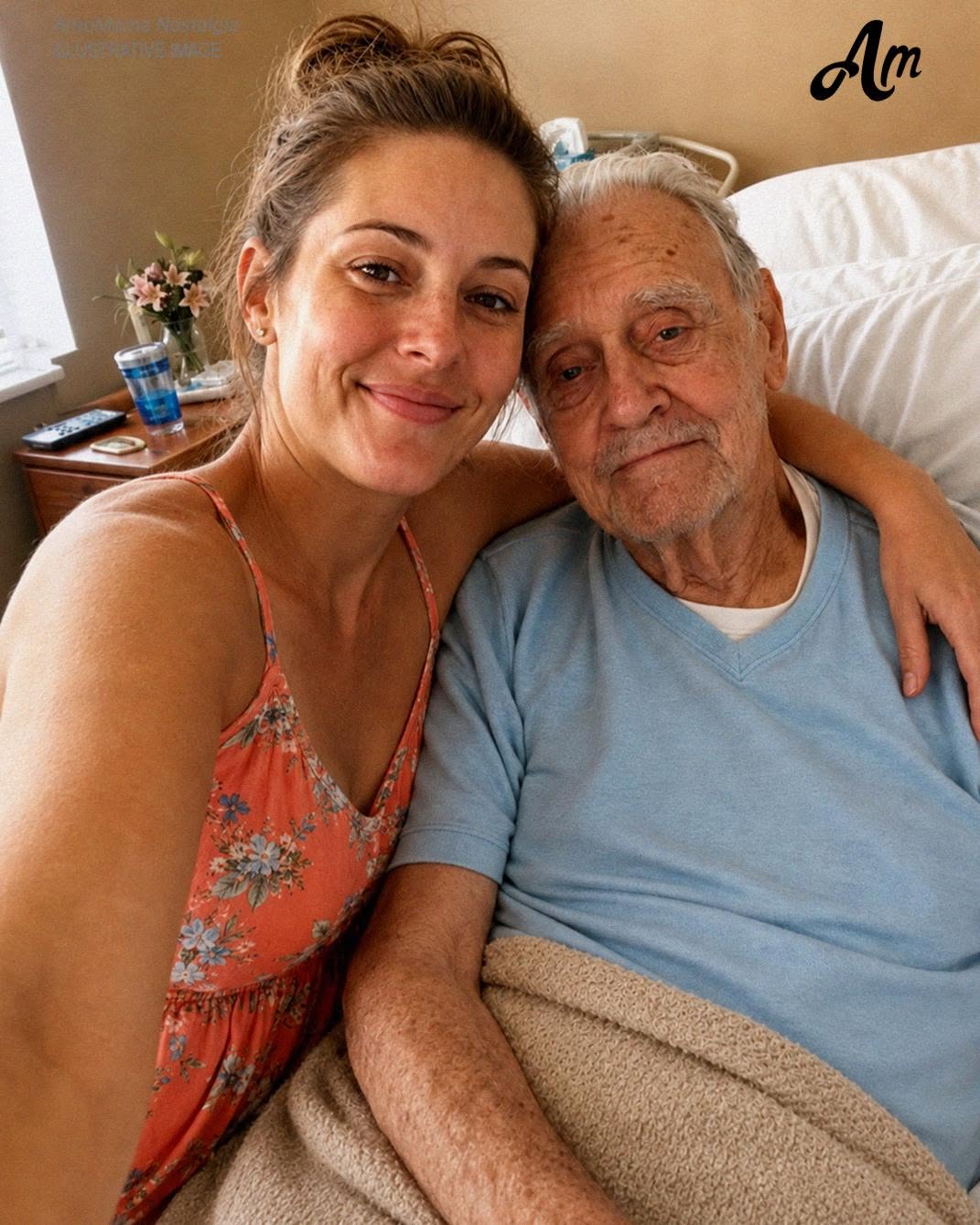
During that time, I was his only regular visitor. I helped feed him. I held his hand through the bad nights. I laughed at the endless stories the fourth and fifth time he told them. And I held his frail hand through his most agonizing days.
We grew incredibly close.
I was his only regular visitor.
***
Then, one autumn afternoon, the elderly man squeezed my fingers and squinted at me as if he were trying to place a memory.
“You know something, kiddo?” he said. “You show up. Nobody ever just shows up.”
I smiled. In that small room, I understood I had quietly found the father I had spent my whole life missing.
And I became the family he never built.
“You show up.”
***
The rain came down in a slow, freezing drizzle the morning we buried Elias last week.
I stood at the graveside in my mom’s old scarf, watching the priest’s breath cloud in the cold air. His funeral was heartbreakingly quiet. Only three of us had shown up.
Father James read from a small, worn book. Ruth, the off-duty hospice nurse, stood beside me with her hands folded in front of her coat. That was it. No cousins or relatives. No old colleagues. No Gregory.
I stood at the graveside.
“He deserved more than this,” I whispered.
Ruth glanced at me, her eyes tired and kind.
“He had you, honey. For two whole years, he had you.”
“That isn’t the same.”
“Maybe not. But it mattered.”
Father James finished the final prayer and stepped back, giving us a moment.
“That isn’t the same.”
I stared at the plain wooden casket and felt something inside fold in on itself.
Elias had spent nearly a century on this earth, and only three of us stood in the rain to say goodbye.
Ruth cleared her throat softly.
“The facility tried, you know. We reached out to the nephew. Called him. Mailed a notice.”
“And?”
“The letter returned unopened. Someone scrawled ‘return to sender’ across the front.”
I closed my eyes.
“The facility tried, you know.”
“He couldn’t even open the envelope.”
“There’s something else, Maya,” Ruth hesitated, then continued. “Gregory called the facility twice this past week. I forgot to mention it because of our different work shifts.”
I turned to her, confused.
“What did he call for?”
“Not about Elias. About you.”
“About me?”
“There’s something else.”
“Yeah, he mentioned that Elias spoke about you. He wanted to know who you were, how long you’d been volunteering, and whether staff had, and I’m quoting him, ‘let some volunteer near his uncle’s paperwork.’ He left you a voicemail at the front desk. I haven’t played it. Didn’t feel right to.”
My throat went dry.
“He thinks I did something illegal?”
“He thinks a lot of things, from the sound of it.”
“He left you a voicemail.”
Father James walked back over, quiet and gentle.
“Are you all right, Maya?”
“I don’t know what I am, Father.”
He nodded, as if that were a perfectly acceptable answer, and rested a hand briefly on my shoulder before stepping away.
I stayed at the grave long after the two of them left. The rain soaked through my scarf, my coat, and my hair. I kept waiting for someone else to come. No one did.
“Are you all right?”
***
Yesterday, I returned to the facility to pack Elias’ personal things before the staff cleared out his room.
Ruth met me at the front desk and handed over an empty cardboard box.
“Take your time. Room’s still yours today.”
“Thank you.”
The hallway felt longer than I remembered. When I pushed open his door, the silence hit me like a wall. His bed was stripped down to the mattress, the thin hospital blanket lying on top.
I returned to the facility.
Elias’ chair by the window sat empty, still tilted at the angle he liked.
I set the box on the floor and sat on the edge of the bed one last time, grieving. For a long moment, I couldn’t move.
“You told me once that dying alone was the price you paid,” I said out loud to no one. “I told you that you weren’t alone anymore. I meant it, Elias.”
There was no answer, of course, just the sound of my own breathing.
I couldn’t move.
I remembered the countless afternoons we’d spent talking and laughing in that room.
Then I started slowly.
- His reading glasses.
- A paperback with a cracked spine.
- A photo of a woman I didn’t recognize, tucked into the drawer beside his rosary.
I ran my fingers along the edges of each thing as if they were sacred.
Then I reached for the blanket.
I smoothed the hospital blanket flat, the way I used to when he was still alive.
I started slowly.
Because the mattress wasn’t that thick, my hand caught on something stiff beneath it. Something rectangular. I froze.
“What in the world…?”
I lifted the corner of the mattress and carefully pulled it free.
It was a thick manila envelope. My full name was written across the front in Elias’ shaky handwriting, as if he’d wanted to make sure no one else could claim it.
My hands started to tremble.
My hand caught on something.
I sank onto the mattress and opened the flap.
Inside were two things: a folded letter, several pages thick, in the same trembling script, and a smaller note, paper-clipped to the front.
The note held only a name, Ms. Daniels, her phone number, and one line beneath it.
“She’ll help you understand. Kiddo, please read this before you decide anything.”
I opened the letter first, my fingers trembling against the thick paper.
The note held only a name.
Elias’ handwriting sprawled across the page, uneven but deliberate.
He wrote that he’d never truly been alone by accident.
Decades ago, he had cut ties with his younger brother’s family after a bitter fight over their mother’s care. She had raised them alone, working two jobs and feeding them on almost nothing.
Elias’ handwriting sprawled across the page.
“I buried myself in work to avoid the guilt,” he wrote. “I built a quiet fortune and had no one to share it with.”
I pressed my hand to my mouth.
My late patient explained that years before we ever met, he’d quietly seeded a small memorial fund at the local community college. He used a generic name, nothing traceable, as private penance for a family he could never repair.
“In my final months, I asked my attorney, Ms. Daniels, to draft a new will. The old one left everything to Gregory, a nephew who never once visited. I couldn’t let that stand.”
He used a generic name.
I picked up the smaller note. My hands were shaking so badly that I could barely read the number.
I dialed.
“Ms. Daniels’ office,” a warm voice answered.
“This is Maya. Elias left me a letter and your office’s number. But I don’t understand any of this.”
“Maya. He told me you might call. Can you come in this afternoon?”
My hands were shaking.
***
Ms. Daniels’ office was quiet, all polished wood and soft lamplight.
She laid documents across the table as if she were setting a place for someone.
“Elias named you the primary beneficiary of his estate,” she said. “And director of a foundation he established.”
The breath left my lungs.
“There’s a foundation?” I managed to utter.
She laid documents across the table.
“There is. And I need to tell you something else. Gregory has been informed. He’s already moving to contest the will. He’s claiming you manipulated a dying man.”
Manipulated? That felt like a slap.
“I never asked Elias for anything. I didn’t even know he had something to give,” I whispered. “I fed him. I held his hand.”
“I know.”
I stood up and reached for my coat.
Gregory has been informed.
“I don’t want it. I never wanted it. Give it to Gregory. Give it to anyone. I won’t be painted as the woman who stole from a family.”
“Maya, please sit down.”
“I can’t. My mother raised me to give, not to take. I won’t have her name attached to this kind of fight.”
Ms. Daniels didn’t stop me.
She said, “Read the rest of his letter first. That’s all I ask.”
“I never wanted it.”
***
My phone buzzed in the elevator going down. An unknown number. I let it go to voicemail.
By the time I reached my car, I already knew who it was.
I heard a clipped, professional voicemail from Gregory’s lawyer.
“Maya, my client is prepared to make this dispute public. We’re aware you volunteer with the hospice program. A prolonged court fight would raise questions about that arrangement. We’d prefer to settle privately.”
My phone buzzed.
I sat in the driver’s seat and stared through the windshield.
Everything I had built, quiet years of showing up for strangers, was now dressed in the language of scandal.
I pulled Elias’ letter from my bag with unsteady hands and turned to the second page.
“Kiddo, I know you. I know your first instinct is to walk away. But this isn’t just about you.”
I kept reading.
I pulled Elias’ letter from my bag.
“For two years you told me about your mother. About the double shifts. About the people she fed when we had nothing. I listened. I listened harder than you know.”
Tears began falling.
“That little fund I told you about? I’ve asked Ms. Daniels to rename it formally in your mother’s name in the final will. To expand it. A full foundation for single mothers working their way out of poverty.”
My vision blurred.
Read also
Tears began falling.
“That’s why you’d never heard of it. It was quiet on purpose. The estate isn’t meant to make you rich. It’s meant to grow that scholarship. I chose you as director because I trust only you to carry your mother and me forward.”
I lowered the letter into my lap.
Elias hadn’t left me money. He’d left me a connection to him and my mom.
He’d listened to every story I told him at that bedside and turned them into something that could outlive us both.
Elias hadn’t left me money.
My phone buzzed again. Gregory’s lawyer, following up.
I wiped my face with the sleeve of my coat and called Ms. Daniels.
“I’d like to schedule a meeting,” I said. “With Gregory. Face to face.”
***
The conference room felt smaller than it looked.
Gregory sat across from me in a pressed gray suit, arms folded, jaw tight.
I wiped my face.
I’d asked Ms. Daniels to invite Ruth and Father James. If Gregory wanted to call me an opportunist, he could say it in front of the two people who’d watched me sit with his uncle.
“Let’s not pretend,” Gregory said. “You’re just a professional gold digger.”
My hands shook under the table, but my voice didn’t.
“I don’t want the house,” I said. “I don’t want the savings. I don’t want a single thing of his.”
“Let’s not pretend.”
I slid the scholarship paperwork toward him.
“Sign off on protecting the foundation in my mother’s name, and everything else is yours.”
Elias’ nephew opened his mouth but failed to respond.
Ms. Daniels quietly placed another folder between us.
Dated bank records. Anonymous donation receipts stretching back years, long before I ever walked into that hospice.
Elias’ nephew opened his mouth.
“Your uncle was funding this scholarship in secret,” the attorney said. “Long before he met Maya. It began as penance for your grandmother.”
Gregory’s face changed. The stiffness drained out of him.
Ruth spoke next, softly.
“I watched Maya sit with him for two years. She never once asked for anything.”
Father James nodded beside her.
“She was there in the rain when no one else came.”
“It began as penance.”
Gregory stared at the receipts. His shoulders dropped.
“I didn’t know my uncle still thought about…,” he murmured. “About Grandma.”
“He never stopped,” I said.
Gregory signed the withdrawal that afternoon.
“He never stopped.”
***
Weeks later, I stood at the back of a small auditorium at the community college. Rows of women, most of them mothers with tired eyes and quiet hope, held their acceptance letters.
I kept only one thing of Elias’ for myself. A framed photo of him smiling, taken the afternoon he first called me kiddo.
“Thank you,” I whispered while pressing my fingers to the glass. “Both of you.”
I hadn’t lost my family. I’d learned how to build one and now, how to pass it forward.