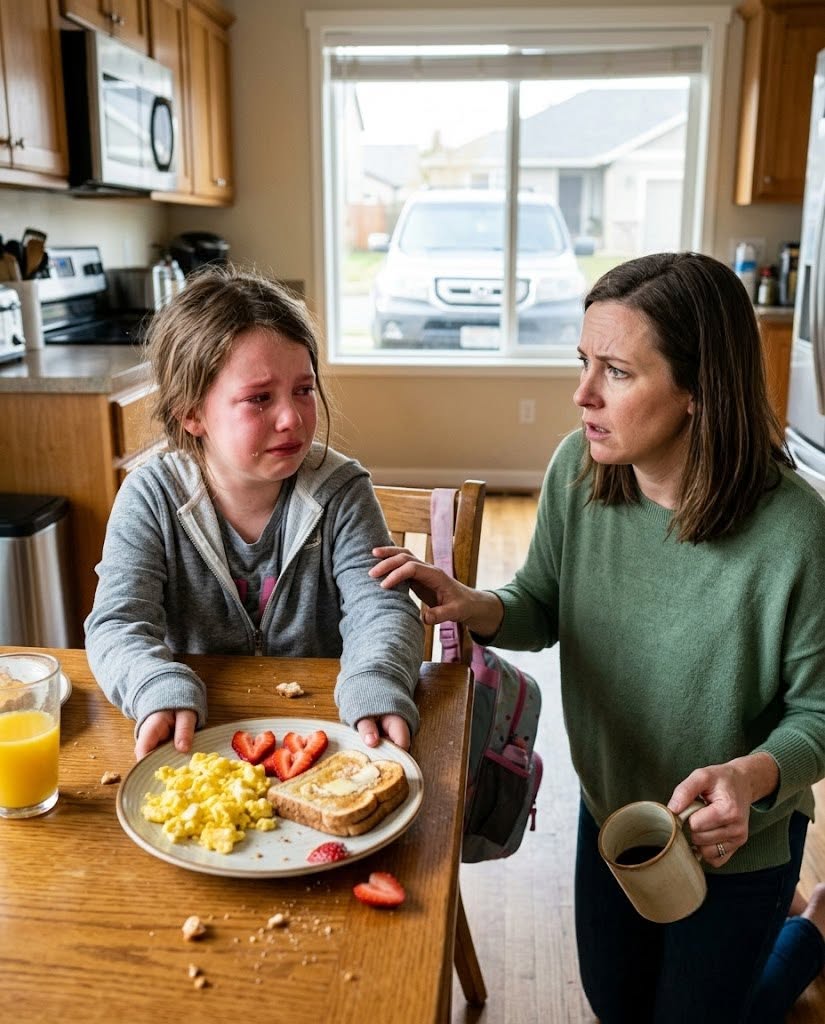
I did not ask Lily to repeat the sentence. I pulled her into my arms and told her the only thing that mattered in that moment: I believed her.
She kept saying she was sorry. Each apology made me understand how carefully my parents had built the trap. They had not only taught her a lie; they had taught her that telling me the truth would cost her my love.
I set my phone on the counter, opened a notebook, and wrote down Lily’s exact words while they were fresh. I did not add conclusions or ask leading questions. I wrote the date, the breakfast on the table, the house she described, the woman Grandma called a lawyer, and Grandpa’s recording.
Then I asked one question. “What happened after he recorded you?”
Lily rubbed her sleeve across her face. “Grandma hugged me and said I did good. Grandpa said we might have to do it again because I didn’t sound sad enough.”
That was the new detail that broke whatever doubt I might have tried to invent for my parents.
Before I could decide whether to call them, my mother called me.
I answered without putting the phone near Lily. Mom sounded cheerful, almost rehearsed. She asked whether Lily had slept well, then said, “We should talk about what’s best for her before you leave again.”
“I’m not leaving,” I said. “And Lily told me about the lawyer.”
The warmth vanished from her voice.
My father came on the line. “She’s confused. Don’t put words in her mouth.”
“I didn’t,” I said. “You did.”
He paused, then made the mistake that changed everything.
“The recording already proves what she wants,” he said. “You can’t undo it now.”
I looked at Lily, still clutching my sleeve, and made a decision my parents never expected.
I told him, “Then you’ll have no objection to letting someone hear the entire recording—not just the part you chose.”
My father gave a short, humorless laugh.
“You’re being dramatic,” he said. “We were trying to protect our granddaughter.”
“From what?”
“From a mother who is never home.”
The accusation landed because it contained one fact wrapped around a lie.
I traveled for work, but Lily was never left alone at night, and this had been my first week-long international trip since she started school.
My parents had volunteered to keep her, sent cheerful updates every day, and told me she was having a wonderful time.
Now I understood those messages differently.
They had not been calming me.
They had been making sure I stayed away long enough for them to rehearse her.
I told my father that all future communication had to be in writing and that neither he nor my mother would be alone with Lily again.
My mother began crying in the background and asked how I could punish them after everything they had done for us.
I almost answered from habit.
For years, I had treated their help as something I could never question because I was a single mother with a demanding job and a mortgage that did not care how tired I was.
Then Lily’s hand tightened around my sleeve.
“I’m not punishing you,” I said. “I’m protecting her from being coached to fear her own mother.”
My father said, “You’ll regret turning this into a war.”
“No,” I replied. “You turned it into one when you recorded a scared child telling a lie.”
I ended the call.
Lily immediately asked whether I had made Grandpa angry.
That question hurt almost as much as the first one.
I told her that adults were responsible for their own feelings and that telling the truth was not the same as causing trouble.
She wanted to know whether a judge was coming to take her that day.
I sat on the kitchen floor beside her and explained only what I knew: nobody was arriving that morning, she was staying home with me, and I would tell her before any adult asked her questions.
I did not promise that nothing difficult would happen.
I promised that she would not face it alone.
After Lily changed clothes and curled up on the couch with a blanket, I photographed the untouched breakfast and the notebook page with the time and her exact words.
The plate was not evidence of a crime or a legal trick.
It was a record for me, because shock has a way of rearranging memory, and I did not want fear to make me careless.
I canceled the errands I had planned and emailed my supervisor that I needed emergency family leave on Monday.
Then I searched for a family-law attorney and left a message describing the situation without using dramatic language.
My parents texted before noon.
Mom wrote that Lily had “expressed concerns” and that they had merely helped her find the words.
I answered with one sentence: “Do not contact Lily directly.”
Dad replied that I could not keep grandparents away because I was embarrassed by the truth.
I saved both messages.
By Sunday evening, he sent another one.
“You should think carefully before attacking people who know your schedule better than anyone.”
That message revealed what he believed his advantage was.
My parents had years of calendars, airport pickups, school pickups, and weekends when Lily stayed with them.
They had mistaken access for parenthood.
They had also mistaken my gratitude for surrender.
On Monday morning, Lily sat beside me while I made breakfast again.
I did not cut the strawberries into hearts this time because the sight of them made her face tighten.
She ate half a piece of toast and asked whether she had to go to school.
I told her she could stay home that day.
Before my appointment, I asked whether she wanted to tell me anything else or whether she wanted to stop talking about it.
She said she wanted to stop.
So we stopped.
That choice mattered.
My parents had spent a week teaching her that adults would keep asking until she gave the answer they wanted.
I needed to show her that “stop” still worked in our house.
The attorney I met that afternoon did not promise me a dramatic victory.
She asked for dates, childcare arrangements, travel records, the messages from my parents, and the exact words Lily had used without my interpretation.
She also told me not to question Lily repeatedly or ask her to perform the story for relatives.
“Your job is to keep her safe and steady,” she said. “Let the adults handle the adult conflict.”
It was the least theatrical advice I received, and it was exactly what I needed.
Through my attorney, we notified my parents that they were not authorized to pick Lily up from school, attend appointments, or arrange any further meeting involving her.
We also asked that the original recording be preserved in full.
My parents’ response arrived through the woman Lily had described.
The lawyer did not discuss private conversations with me, but she confirmed through counsel that there would be no further interview of Lily at her home and that any recording already provided would be retained.
That was when my parents’ story began to fracture.
They had apparently presented themselves as Lily’s consistent caregivers and described my work travel as a pattern of abandonment.
They had not explained that I had been away for one scheduled week, that they had volunteered, or that Lily lived with me full time.
They had also not explained that they told a nine-year-old a judge could make her stay with them forever if she “said it right.”
My mother called from a different number after I blocked hers.
I let it go to voicemail.
Her message started with tears and ended with blame.
She said they had been afraid I would move away, take a new job, and reduce their time with Lily.
That was the first honest motive anyone gave me.
They were not rescuing Lily from neglect.
They were trying to prevent a future they could not control.
My work travel had become the excuse, but access was the real issue.
They wanted the right to see my daughter whenever they chose, and when they imagined losing that right, they decided to make themselves indispensable on paper.
The full recording arrived through counsel two days later.
I listened once, with my attorney present, and then I never played it in front of Lily.
The video began before my father intended.
His voice was clear.
“Start again,” he said. “Tell her you get scared when your mom leaves.”
Lily’s crying voice answered, “But I don’t.”
My mother said, “Honey, we practiced this.”
There was a rustle, a pause, and my father’s sharper voice.
“If you want to stay with people who are always here, you have to explain why.”
Then the clip they had planned to use began.
Lily said I left her alone at night.
She cried because she was terrified, not because the words were true.
My parents had believed the tears would make the lie convincing.
Instead, the untrimmed beginning showed exactly how the tears had been created.
I did not feel triumphant.
I felt sick.
There is no satisfying feeling in hearing your child beg adults she trusts to let her tell the truth.
My attorney asked whether I wanted to pursue an immediate court order limiting contact.
I asked what would keep Lily safest without forcing her into more interviews than necessary.
We chose the narrowest step first.
My parents received written notice that all contact had to go through me or counsel and that any future time with Lily would require my agreement and supervision.
The school received updated pickup instructions.
My neighbor, who already knew Lily, agreed to be my emergency contact while I arranged a longer-term plan.
I also told my supervisor I would no longer accept overnight travel until I could build childcare that did not depend on my parents.
That decision cost me.
A major account I had worked toward for months went to someone else.
For one evening, I sat at the kitchen table staring at the email and feeling the old panic about money press against my ribs.
My parents had counted on that panic.
They knew I needed reliable childcare and believed need would eventually force me to forgive them on their terms.
I decided I could grieve the lost opportunity without trading Lily’s safety to get it back.
Three days later, my parents came to the house.
My father stood on the porch holding a manila envelope, and my mother kept glancing toward the front window as if Lily might run into her arms.
I stepped outside and closed the door behind me.
Dad held out the envelope.
It contained printed photos of family vacations, school events, and weekends at their house.
“These prove we’ve been there,” he said.
“They prove I trusted you,” I answered.
My mother said, “We made one mistake.”
“No,” I said. “You made a plan, took her to a lawyer, rehearsed a false statement, recorded it, and warned her that I would hate her if she told me.”
She looked toward the door again.
“We love her.”
“I believe you love her,” I said. “I also believe you were willing to frighten her to keep control of her.”
My father’s jaw tightened.
He said I was destroying the family over something Lily would forget.
That sentence ended the last part of me that wanted to make the conversation comfortable.
“She may forget the address of that house,” I said. “She may forget what the room looked like. She will not forget being told that her mother’s love depended on silence.”
Mom asked to see her for one minute.
I said no.
Dad stepped closer and lowered his voice.
“You need us.”
He was right in one narrow, practical sense.
I needed help.
I needed school pickups, backup care, someone to call when a flight was delayed, and people who loved Lily.
But needing help did not mean I had to accept help that came with ownership attached.
“I needed parents I could trust,” I told him. “That is not the same thing as needing access at any price.”
I handed the envelope back.
My mother did not take it, so my father tucked it beneath his arm.
They left without seeing Lily.
From the upstairs window, she watched their car pull away.
I had not known she was there until she came down and asked, “Did Grandma cry?”
“Yes.”
“Is it my fault?”
“No.”
She studied my face as if she expected the answer to change.
Then she asked the question that revealed how deeply the week had reached into her.
“What if she’s sad forever?”
I told her that loving someone did not make her responsible for fixing every feeling they created.
She leaned against me, and we stood in the hallway without trying to solve anything else.
Over the next month, my parents sent letters.
Some apologized.
Some explained.
Some accused me of cruelty.
I kept the ones that took responsibility and gave the others to my attorney.
I did not make Lily read any of them.
My mother eventually wrote a letter that did not ask for a visit.
She admitted telling Lily that I might send her away.
She admitted that fear of losing access had made her justify things she knew were wrong.
She did not excuse my father’s recording, but she also did not fully confront her role in it.
It was not a perfect apology.
It was the first one that did not demand payment.
I still did not restore contact.
An apology could be a beginning, but it was not proof that Lily would be safe from pressure.
My father never apologized directly.
He wrote that history would judge whether he had been right to intervene.
I stopped answering him.
Lily began seeing a counselor who focused on helping her separate truth from responsibility.
The counselor did not interrogate her about the recording.
They talked about body signals, safe adults, and what it feels like when someone asks for a secret that makes your stomach hurt.
At home, we created a simple rule.
No adult was allowed to ask Lily to keep a secret from me about where she had been, who she had met, or what she had been told to say.
Surprises like birthday presents were different because they had an ending.
Secrets that made her afraid did not belong in our family.
I also changed how I spoke about work.
Before, I had tried to protect Lily from my stress by saying trips were “no big deal.”
Afterward, I showed her the calendar, told her who would be with her, and gave her a choice about how often we checked in.
I wanted her to know that plans involving her were not things adults whispered over her head.
Months passed before she stopped asking whether ordinary mistakes would make me leave.
A spilled cup of milk brought tears.
A forgotten homework page brought a trembling apology.
Each time, I answered the same way.
“You can be in trouble for a choice, and you can still be loved. Those are not opposites.”
My parents had used love as a verdict.
I wanted Lily to experience it as something steadier.
The legal threat never became the battle my father predicted.
Once the complete recording and messages were preserved, my parents did not move forward with their attempt to change Lily’s living arrangement.
Their lawyer ended her involvement, and there was no coached child left for them to present.
The practical outcome was quiet.
Lily stayed home.
My parents had no unsupervised access.
Any future contact would depend on sustained accountability, professional guidance, and Lily’s comfort—not their demands.
I lost the account at work, but I did not lose my job.
Over time, I built a small network of backup care through people who did not confuse helping with owning.
It was less convenient than calling my parents.
It was safer.
Almost a year after that Saturday morning, Lily walked into the kitchen while I was cutting strawberries.
She watched me for a moment, then took the largest one from the cutting board.
I waited.
She bit into it and smiled.
“Can I have another?”
I slid the whole bowl toward her.
The first time she had stared at those strawberries, she believed one wrong answer could cost her home.
Now she took what she wanted without asking whether she was in trouble.
That was how I knew we were healing—not because the past had disappeared, but because breakfast had become breakfast again.