The Box
Two years ago, after my mother passed away, I began volunteering at a small care center on Tuesdays and Thursdays, mostly because I needed somewhere to put my grief that wasn’t my apartment.
Grief is territorial. It will occupy every space you give it. I had learned this in the first weeks after losing my mother, when I had taken bereavement leave from my job at the university library and spent eleven days in my apartment watching the light move across the walls and eating crackers directly from the box because the act of making food felt like an argument I didn’t want to have with myself.
Pregnancy& Maternity
On the twelfth day, I got dressed and drove to the Harborview Care Center and told the volunteer coordinator I had time on Tuesdays and Thursdays.
She asked what I was good at. I said listening. She put me to work.
The center had forty-two residents when I arrived, and within three weeks I knew most of them by name and by the particular things they liked and didn’t like—who wanted the window blinds adjusted and who didn’t, who appreciated being read to and who preferred quiet, who had family that visited regularly and who was waiting for visits that rarely came.
Nathan was in the second category.
He had a corner room on the second floor with a view of the parking lot that he had arranged to make the most of—a small table near the window, a folding chair positioned at the angle that caught the afternoon light, and a collection of paperback novels organized by author on the shelf beside his bed. The novels were well-read. Their spines were soft with use.
He was fifty-nine when I met him, which is younger than most people expect when you say someone lives in a care center. He had been there for eight months, following a cardiac event that had left him with limitations that made independent living impractical without support. He was not confused or diminished in mind—his mind was sharp in the particular way of people who have spent a lot of time thinking. He had simply been a person who lived alone and whose body had made certain decisions.
I started stopping by his room because he was always awake when I passed it.
Not waiting for anything, it seemed. Just awake, reading, with the lamp on and the evening settling outside the parking lot window.
The first conversation lasted forty minutes and covered the novels of John Updike, the best way to make chili, and the quality of care center coffee, which Nathan described with the specific resignation of someone who has accepted a situation they cannot improve.
I brought him better coffee the following Tuesday.
He thanked me with the seriousness of someone receiving something that matters.
After that, we talked every visit. I stayed past the end of my shift routinely enough that the evening nurse, a woman named Maria who had been at the center for twelve years, started leaving my visitor’s badge in a particular spot so I didn’t have to check in each time.
Nathan had a way of listening that felt like being taken seriously. Not the way of someone performing interest, but the way of someone who was genuinely curious about the answer to the question he had asked. I found myself talking about my mother, which I had not been able to do with most people without the conversation becoming about their own grief or their own discomfort. Nathan asked questions and then listened to the answers, and then asked more.
“You said she raised you alone,” he said one evening, about six weeks in.
“Yes. It was always just us.”
“Your father?”
“Gone before I was born. She never talked about him. I stopped asking when I was about twelve because I could see it cost her something.”
Nathan was quiet for a moment. “You don’t know anything about him?”
“Not even his name,” I said. “She took that to her grave. I don’t know if that was deliberate or just—something she thought we’d get around to and then didn’t.”
He looked at the window.
“Sometimes things get away from us,” he said.
“Yes,” I said.
We were quiet together for a while, which was one of the things I had come to value about our friendship—the comfortable quality of the silence between us. Most silences I experienced with people were slightly pressurized, both parties waiting for the other to fill them. Nathan’s silences felt like rest.
It was a Thursday in late April when he said the thing that changed us.
He had been quieter than usual that week. The doctor had adjusted his medication, and the adjustment had made him tired in a way that was different from ordinary tiredness—a deeper tiredness, the kind that comes when a body is working harder than its visible activities would suggest.
I had brought coffee and a small notebook he had asked me to pick up—he had started writing something, though he wouldn’t tell me what—and I was sitting in the folding chair by the window when he set down the book he’d been pretending to read and looked at me.
“I have something I want to ask you,” he said.
“All right.”
He was quiet for a moment, organizing the words.
“I have one last wish,” he said. “And I know it sounds strange. But I’d like you to pretend to be my daughter. While I’m still here.” He looked at his hands. “I had a daughter. Life separated me from her before she was even born. And I—” he stopped. “I’ve been thinking about her most of my life, and I’m tired of thinking about her without having anyone to think about her with.”
I sat with that.
My mother had raised me alone. My father had been gone before I was born. I had spent my childhood understanding the word father as an absence rather than a presence—something other children had that I did not, the way some children don’t have grandparents or siblings, an ordinary kind of lack.
The request should have felt strange.
It didn’t.
It felt like something I recognized from the inside.
“Well then,” I said. “Hello, Dad.”
Nathan laughed. It was the best I had heard him laugh in six weeks.
For the next six weeks, we were something I don’t have a single word for. The word family is the closest, but it undersells the deliberateness of it—we had chosen this, both of us, which made it feel more binding in some ways than things that happen by circumstance.
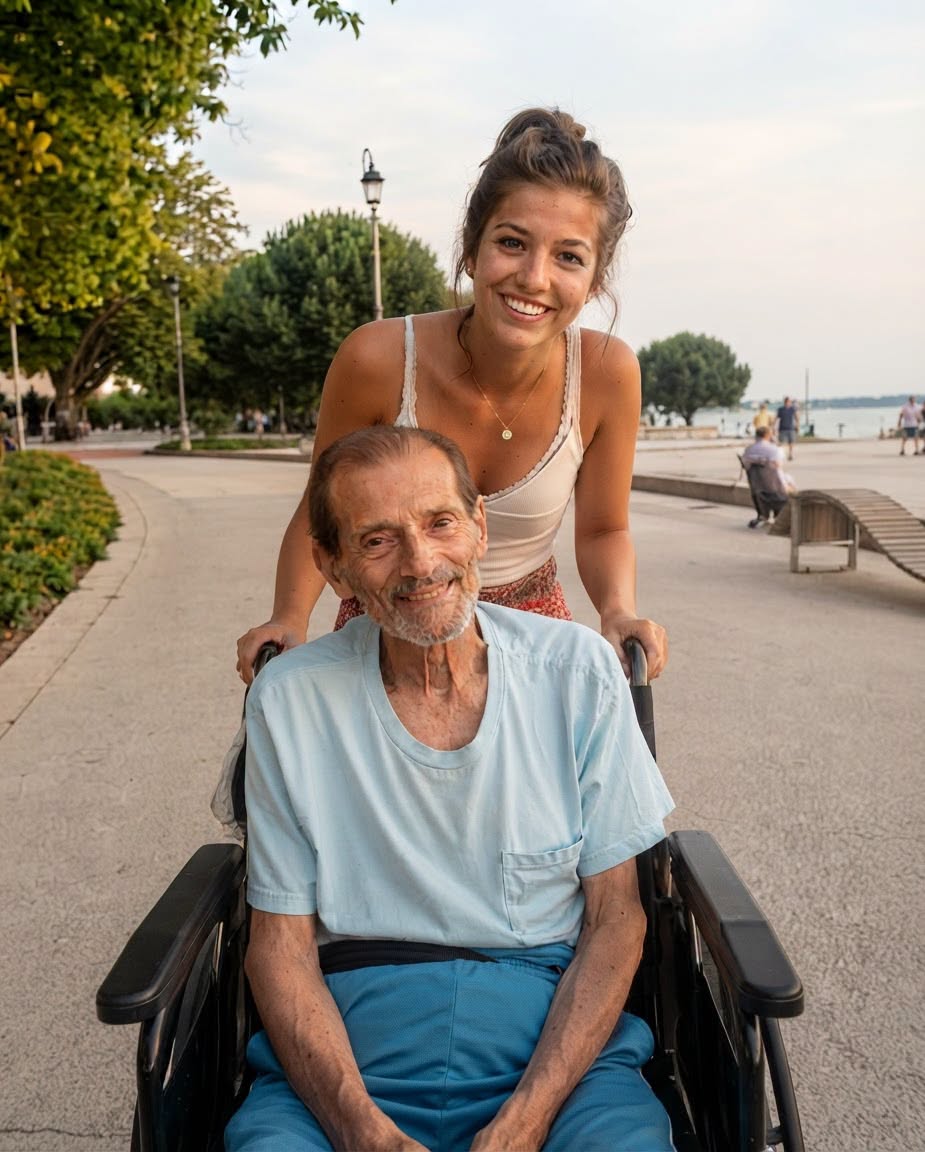
I pushed his wheelchair through the center’s garden on good days. I took him to the diner three blocks from the center on two occasions—he had a specific fondness for their patty melt that I found endearing and he found completely reasonable. I drove him to the ocean on the fourth Saturday in May, because he had mentioned once that he hadn’t felt sand under his feet in four years and I had decided that was unacceptable.
We sat on a blanket above the tide line for three hours. He took his shoes off and worked his way down the sand on his own feet, slowly, and stood at the edge of the water with his hands in his pockets and his face toward the horizon. I stayed back to give him the moment. When he turned around, his eyes were bright.
“Thank you,” he said.
“We can come back,” I said.
“Yes,” he said. “We can.”
When strangers asked about our relationship—at the diner, on the beach, in the garden—he would say, “This is my daughter,” with the ease of someone stating a fact. Not performing it. Stating it.
I knew what we were and what we weren’t. I also knew what we had become, which was real regardless of its origins.
I was, in those six weeks, the happiest I had been since before my mother’s illness.
Nathan died peacefully in his sleep on the first Thursday in June, twelve days after our last visit.
Maria called me before eight in the morning. I drove to the center and sat in the garden for an hour before I could make myself leave. Maria brought me coffee from the good machine the staff kept in the break room.
“He talked about you,” she said.
“I know he did,” I said. “He told me he did.”
“He was different after you started visiting. People are, sometimes, when they have someone.”
I came back for the memorial, which was small—the center staff, two people from a church he had attended years ago and stayed in contact with, and me. The minister who spoke had never met Nathan and made him sound generic in the way of people who work from notes rather than knowledge. I spoke after and tried to make him specific—the patty melt, the paperbacks, the particular quality of his attention when he was listening. I’m not sure I succeeded.
Afterward, I drove home and spent the evening in the way I had learned to spend difficult evenings: making something with my hands. I baked bread, which is both occupation and meditation, and I let the apartment fill with the smell of it.
The lawyer found me at the center the following afternoon.
I had gone back to return the visitor’s badge I had been keeping, which felt like a necessary closure, and I was standing in the lobby when a man in a gray suit came through the entrance and spoke to the receptionist, who gestured toward me.
He was perhaps sixty-five, a compact man with silver-rimmed glasses and the particular manner of someone who has delivered difficult information many times and has developed a careful way of approaching it.
“Ms. Eleanor Marsh?” he said.
“Yes.”
“I’m Richard Calloway. I was Nathan Greer’s attorney.” He paused. “I was told you would likely be here today. I have something for you, and some things I need to tell you. Is there somewhere we could sit?”
There was a small meeting room off the lobby that the center used for family conferences. We sat there.
He placed a wooden box on the table between us. Not large—the size of a document box, but made of dark wood with a brass clasp, the kind of thing that looks like it has been kept carefully for a long time.
“Nathan chose this care center specifically because you volunteered here,” he said.
I stared at him.
“He had been looking for you for twenty years,” he said. “He made me promise to share the full truth only after he was gone. You should probably prepare yourself.”
I looked at the box. My hands were in my lap and they felt very far away.
“Nathan Greer,” the lawyer said, “was your father.”
The room was very quiet.
“Your mother’s name was Catherine Marsh, before she married. She and Nathan met in 1985. They were together for approximately eight months. Your mother became pregnant and then—through a set of circumstances I’ll explain—they lost contact. Nathan didn’t know about the pregnancy until you were almost two years old, when he received a letter from your mother. By that point, she had made a decision about her life, and the letter was not an invitation to be part of it. It was a notification.”
“A notification,” I said.
“She wanted him to know he had a daughter. She did not want him to contact either of you. She provided no last name, no address, no photograph. Just your first name. Eleanor.” He paused. “He hired investigators twice over the years. The first time, when you were seven, they found nothing conclusive. The second time, when you were in your early twenties, they identified two women who matched the available information. You were one of them.”
“He knew for—”
“He wasn’t certain,” the lawyer said carefully. “He had a strong belief. But your mother was gone, and he had no way to confirm without approaching you directly, and he had made certain decisions about how to handle that.”
“What decisions?”
“He decided he would not appear in your life uninvited,” the lawyer said. “He had spent a great deal of time thinking about what he had a right to and what he didn’t. He believed he had forfeited certain rights by not finding you sooner. By not trying hard enough, earlier. He carried significant guilt about that.”
“So he—” I tried to assemble it. “He arranged to be at a care center where I volunteered.”
“He had a cardiac event in the spring of 2022. He genuinely required care—I don’t want you to think this was an elaborate fiction. He needed to be somewhere. He had done research on facilities in the area and he had also, by then, confirmed through a colleague that you volunteered at Harborview.” The lawyer looked at his hands. “He chose Harborview. And then he waited to see what happened.”
“He waited to see what happened,” I said.
“He told me he wanted to know you. Not to claim you—those are his words, from a letter he wrote me last year that I’ll give you shortly. Not to disrupt your life. Not to arrive as a revelation you hadn’t consented to. He wanted to know you as you actually were.” The lawyer paused. “And then when you came to his room and kept coming back, and when—” he stopped, recalibrating. “When the two of you arrived at what you arrived at, he—”
“He was living it,” I said.
“Yes. He told me afterward that the six weeks were the—” the lawyer looked at the box, “—I’m going to use his exact words from the letter, which is easier than paraphrasing. He said they were ‘the six weeks I have been reaching toward my whole life without knowing how to reach them.’”
I put my hands on the table.
“Why didn’t he tell me?” I said.
“He was afraid,” the lawyer said simply. “He was afraid that if he told you the truth, you would feel deceived by the request. That the six weeks would become contaminated by the knowledge of why he made them. He wanted—” he paused again. “He wanted you to have it cleanly. As what it was. And he wanted to tell you the truth, but he wanted to do it when he couldn’t see your face while you processed it. Because he thought watching you process it would be more than he could hold.”
I looked at the wooden box.
“What’s in it?” I said.
“His explanation,” the lawyer said. “In his own words, in a letter he wrote in January and revised in April. Some photographs. A document that is also in the box—a DNA test, which he had conducted without your knowledge from a coffee cup. He wanted to be certain before he arranged anything. He was certain.”
“He had my DNA tested without telling me,” I said.
“Yes,” the lawyer said. “I want to be honest about that. He crossed a line there and he knew it and he says so in the letter. He’s not asking you to forgive him for it. He’s asking you to understand why.”
I was quiet.
“There is also,” the lawyer said, “a separate envelope. Not in the box. I have it here.” He placed a standard legal envelope on the table beside the box. “Nathan had modest savings, but over the years he made specific investments with—he described it as a specific intention. He was, in case you were ever in his life, setting something aside. The investments have done well. The envelope contains the documentation.”
I looked at the envelope.
“How much?” I said.
The lawyer told me.
I looked at the table.
“He was doing that for twenty years?” I said.
“Yes. From the letter: ‘I could not give her a father. I could try to give her something else.’”
The room was very quiet.
I carried the box to my car.
I sat in the driver’s seat for a while without starting the engine. The afternoon was doing the things afternoons do in June—warm, slightly overcast, the particular quality of light that makes everything look considered.
I thought about the first Tuesday I had stopped at Nathan’s door.
I thought about his way of listening.
I thought about the ocean, and his face at the edge of the water.
I thought about the Thursday evenings when I would tell him about my mother, and the specific quality of his attention when I did—how he never interrupted, how he asked the exact right questions, how he seemed to understand things about her without being told them.
He had loved her once. He had lost her. He had spent twenty years constructing a careful approach to the daughter he couldn’t claim directly. He had sat in a corner room with a view of a parking lot and waited to see who I was.
He had found out.
I opened the box.
The letter was long—twelve handwritten pages in a script that was precise and slightly cramped, the handwriting of someone who had spent time making their words legible. I read it in the car, in the parking lot, while the afternoon light changed.
He wrote about my mother as she had been at twenty-four—her laugh, the specific way she argued about things she cared about, her habit of doing two things at once and doing both of them well. He wrote about the eight months and the separation that had been nobody’s fault and everybody’s fault simultaneously—a misunderstanding that became a distance that became an absence before either of them knew what was happening.
He wrote about receiving her letter.
He wrote: I read it perhaps forty times in the first week. I was trying to find the part where she said I could find you. I kept thinking I had missed it. I had not missed it. There was no such part. She had told me you existed, and she had also told me, as clearly as a person can tell someone something without using those exact words, that I was not to come.
He wrote about the investigations. He wrote about the decision he had made and remade over the years about whether he had the right to appear in my life. He wrote about the cardiac event with a kind of dark humor—my heart finally making the decision my mind had been unable to make, which is that it was time to go find her.
He wrote about Harborview.
He wrote: I want to be honest with you about what I was doing when I chose that care center. I was arranging an opportunity to see what kind of person you had become, without the pressure of you having to decide how to feel about me before you knew me. I understand this could be read as manipulation. I have thought about it that way too. I have also thought about it as the only way I knew how to be near you without asking you to carry the weight of something you had no part in creating.
He wrote about the request.
When I asked you to pretend to be my daughter, I want you to know that I was not pretending. I was not performing something false. I was saying what was true in the only way available to me, with the parts I couldn’t say left out because I was a coward about them. The pretending was not that you were my daughter. The pretending was that I didn’t already know it.
He wrote about the six weeks.
I have had very little that I would call happiness. I want to be accurate about this. I have had satisfaction, and I have had purpose, and I have had good work and some good friendships. But happiness is specific. It is the ocean with sand under your feet and your daughter standing back to give you the moment. It is coffee you didn’t expect. It is a joke about care center decaf. It is being listened to by someone who came back when they didn’t have to.
The six weeks are what I was looking for when I came to Harborview. I did not expect to find them so fully.
The last page was brief.
I don’t know what you’ll feel when you read this. I’ve imagined many versions. In some of them you’re angry, which is reasonable. In some you’re sad, which is also reasonable. In one version, which is the one I fall asleep hoping for, you understand that I couldn’t find a way to have you in my life that wasn’t already what we had—that the pretending was just the frame, and the frame was a kindness I was extending to both of us.
I am sorry I couldn’t be your father for thirty years. I was your father for six weeks, and I want you to know it was the best thing I ever did.
With love, which I know I haven’t earned but which is what I have—
Nathan
I called my mother’s oldest friend that evening.
Patricia had known my mother since they were in their twenties and had been at the funeral and had called me every few weeks since, the way she had always done, because she had known me since I was four years old and understood herself to have a role in my life that didn’t require being asked.
“Patricia,” I said. “I need to tell you something, and then I need to ask you something.”
I told her about Nathan. All of it—the care center, the six weeks, the lawyer, the letter, the DNA test. I told her while I walked circles around my kitchen because I could not be still, and she listened with the quality of silence that comes from someone who is hearing hard news and is not going to rush past it.
When I finished, she was quiet for a moment.
“Patricia,” I said. “Did you know about my father?”
A pause that was slightly too long.
“Patricia.”
“Your mother told me his first name,” she said. “And that she had contacted him. And that she had decided.” Another pause. “She told me she had written to him to tell him you existed, and that she had also told him not to come.”
“Why didn’t she want him to come?”
Patricia was quiet again.
“She was afraid,” she said finally. “Not of him—she didn’t think badly of him, Eleanor. She was afraid of building something and having it fall apart. She had built something with just the two of you, and it worked, and she couldn’t—she couldn’t risk you losing another person. That was how she thought about it.”
“She was protecting me,” I said.
“Yes. Whether that was right—” Patricia stopped. “I have thought about it many times. Whether she should have made that choice for both of you. I don’t know. I think she made the best decision she knew how to make with what she had.”
“He was looking for me for twenty years,” I said.
“I know,” Patricia said. “I know that now.”
We were quiet.
“He found you,” she said, gently.
“He found me.”
“And you had six weeks.”
“We had six weeks,” I said.
“That’s not nothing,” she said. “Eleanor. That’s not nothing.”
I went back to the ocean the following Sunday.
I drove to the same beach, parked in the same lot, carried the same blanket I had brought when Nathan and I had come in May. I took off my shoes at the edge of the dry sand and walked down to the water.
I stood where he had stood.
The horizon was the same horizon. The water moved the way water moves, without any awareness of what has happened on its shores.
I thought about my mother at twenty-four, and Nathan at twenty-four, and the eight months and the misunderstanding and the letter. I thought about the care center and the corner room and the coffee I had brought the second Tuesday. I thought about twelve handwritten pages in a precise, cramped script.
I thought about what it meant to be known.
Nathan had known me—had observed me over six weeks with the specific attention of someone looking for things they had been wondering about for a long time. He had found my laugh and my stubbornness and my way of being silent and the particular things that moved me, and he had loved what he found. Not because I was his daughter, or not only because of that. Because of who I was. He had chosen to be near me because of who I was, which is the thing we all want from the people who love us and which is not guaranteed even in the oldest relationships.
He had set money aside for twenty years.
He had carried a coffee cup to a lawyer.
He had arranged himself into a corner room with a view of a parking lot and waited.
I stood at the edge of the water for a long time.
Then I said, out loud, to the horizon: “Hello, Dad.”
The ocean said nothing back, which was fine.
He had heard it the first time.
THE END