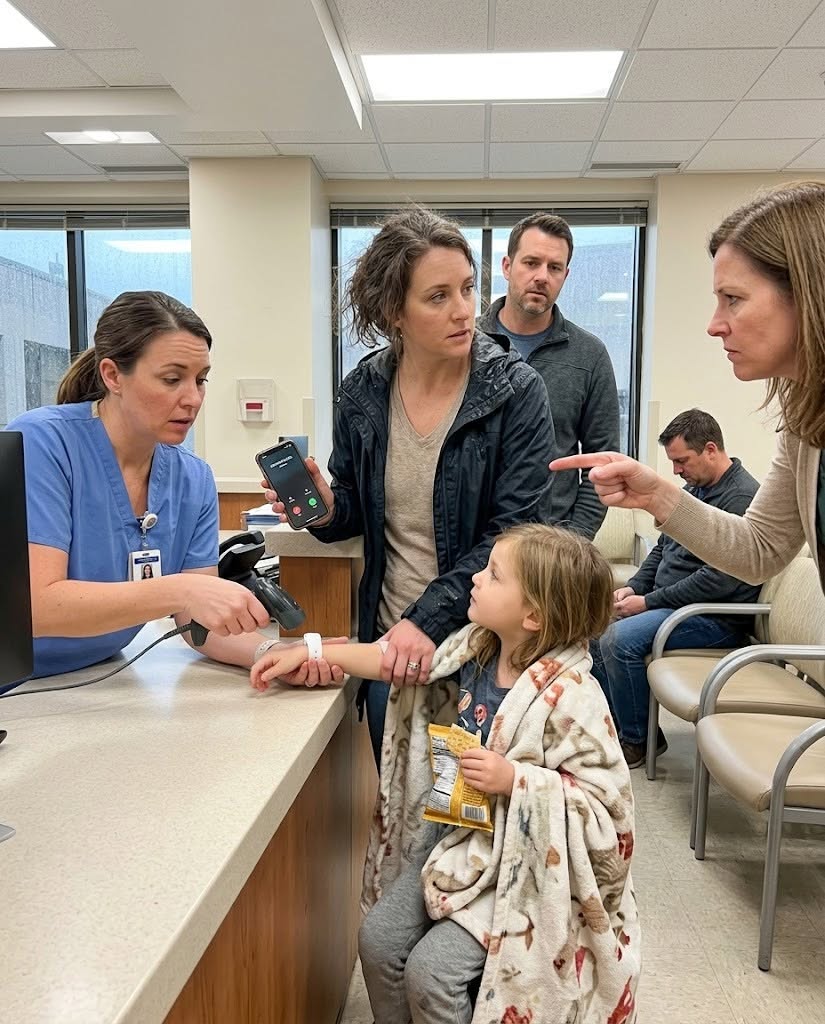
Walt said, “She would not stay where we put her.”
The words landed harder than a denial because he spoke as if a locked closet were a reasonable answer to a child’s disobedience.
Gloria turned on him. “That is not what happened,” she snapped, but the nurse had already stopped looking at me. Her attention stayed on them.
I opened the photos and placed my phone on the counter where everyone could see it. The metal latch filled the screen, screwed into the doorframe at adult height. The next image showed the Christmas bins stacked against the door. The next showed Lizzy wrapped in my jacket in the passenger seat, her knees pulled to her chest.
The nurse asked Lizzy one quiet question. “Could you open that door from inside?”
Lizzy tightened her fingers around mine and shook her head.
Gloria reached toward her. I moved between them before her hand crossed the blanket.
“Do not touch her,” I said.
My mother looked at Adam, then at the nurse, searching for the person most likely to accept her version. “Natalie broke into our house and took a child under our legal care.”
“After the child called her from a locked closet,” the nurse replied, keeping her voice level as she wrote the exact words into the chart.
That changed the room.
The argument was no longer about whether I had entered without permission. It was about why a six-year-old had needed to whisper for rescue.
The nurse asked the intake desk to keep Lizzy with us while the concerns were documented. Gloria protested, but Walt stared at the floor.
Then Lizzy lifted her bracelet toward the scanner and whispered one more thing—something she had been too frightened to tell me in the car.
“They left while I was still inside.”
The nurse’s pen stopped above the chart.
For the first time since Gloria entered the ER, she looked less interested in controlling me than in controlling what Lizzy might say next.
She stepped forward, but the nurse raised one hand without touching her.
“Please stay where you are,” she said.
There was no speech in her voice and no performance. It was the same practical tone she had used when fastening the bracelet, but now every word created distance between Lizzy and the people demanding that she be returned.
The nurse asked Lizzy whether she had been alone in the house.
Lizzy nodded against my shoulder.
Gloria immediately said they had only stepped out for a short time and had expected Lizzy to be asleep.
The explanation might have sounded almost ordinary if the closet door had not required an adult hand to unlatch it from the hallway.
The nurse looked at the photograph again.
The latch was not hidden by darkness or blurred by motion. My phone had caught the metal plate, the screws, the narrow bar, and the edge of the doorframe clearly enough that no one needed me to explain how it worked.
Walt rubbed both palms over his knees.
He still would not look at Lizzy.
Gloria said the closet was not really a closet. It was a storage space with coats, and Lizzy had gone inside during a tantrum.
The nurse asked why the Christmas bins were stacked against the door.
Gloria said they were always stored there.
I swiped to the hallway photograph and enlarged it.
The floor beneath the bins was clean except for the fresh curved tracks where the plastic bottoms had been dragged across it.
I had not noticed those marks while taking the picture. At the time, I was trying to get Lizzy out, keep my hands steady, and remember that evidence mattered because my parents had spent years turning every concern into a misunderstanding.
Now the tracks made Gloria’s answer harder to hold.
The nurse did not accuse her of lying.
She simply wrote down what each person said.
That restraint unsettled my mother more than shouting would have.
Gloria knew how to fight anger. She could call it instability, disrespect, ingratitude, or proof that the angry person could not be trusted.
A careful record gave her nothing emotional to grab.
She turned back to me.
“You have always wanted to take her,” she said. “You have been waiting for Ian to fail so you could make yourself look like the good one.”
Ian’s name hit the room like another threat.
My brother had entered treatment because he knew he could not care for Lizzy safely while he was trying to get well. He had not handed her over because he stopped loving her. He had asked our parents to provide structure until he could stand on his own again.
Gloria and Walt had treated that temporary need as proof that their judgment could not be questioned.
At family dinners, they spoke about schedules, school forms, and routines with the confidence of people reading from a prepared report.
When I asked Lizzy simple questions, Gloria answered for her.
When Lizzy flinched at a raised voice, Walt said she was dramatic.
When I noticed her sleeves hanging looser, Gloria said children grew in strange bursts.
Each answer was plausible by itself.
Together, they had built a wall I had been too cautious to climb until a six-year-old called me from behind a real one.
I looked at my mother and said, “This is not about what I wanted. She called for help.”
Gloria pointed at the broken-window photo.
“You committed a crime to get into our home.”
I did not deny breaking the glass.
I told the nurse exactly what I had done: knocked on the front door, called out, walked around the house, used a landscaping rock, climbed through the kitchen window, found the bins, lifted the latch, carried Lizzy out, and photographed the scene before leaving.
My account did not make me look polished.
It made the sequence clear.
Adam moved closer to the counter and said he had heard me answer the call at home.
He had watched my face change before I woke him fully.
He had stayed with Noah at first because I told him our son needed one calm parent in the house, then joined me once Noah was safely cared for.
Adam did not claim to have seen the closet or the latch.
He only confirmed the part he actually knew.
The nurse recorded that too.
Walt finally looked up.
“She exaggerates,” he said, meaning Lizzy.
The nurse asked, “Which part?”
He opened his mouth, but the question required him to choose.
Was Lizzy exaggerating that she had been locked in?
The photograph showed the latch.
Was she exaggerating that she could not get out?
The latch was outside.
Was she exaggerating that she had been left alone?
Their dark house and unanswered door did not prove every minute, but Gloria had already admitted they stepped out.
Was she exaggerating that she was hungry?
The child had arrived clutching my jacket and eating crackers as quietly as if food were a privilege she needed permission to accept.
Walt looked at Gloria.
That was the first time he asked her face what to say.
My mother saw it and moved quickly.
She lowered her voice and told the nurse Lizzy had been having behavior problems since Ian entered treatment.
She said the child stole snacks, refused bedtime, and hid when corrected.
Those claims were new to me, but they were not offered as requests for help.
They were offered as permission.
The nurse asked whether any care provider had instructed them to secure a storage closet from the outside.
Gloria said no one had instructed them to lock Lizzy in anything.
The sentence sounded like a denial until the nurse asked, “Then who installed the latch?”
Walt answered before Gloria could stop him.
“I did.”
The room did not erupt.
No one needed it to.
The important fact had been spoken by the man whose garage held the same hardware.
He immediately tried to narrow what he had admitted.
He said he installed the latch to keep Lizzy away from stored decorations and household items.
I showed the photograph of the latch positioned on the hallway side of the door.
If it had been meant to keep a child from entering, it could have been used while the room was empty.
Instead, Lizzy had been found behind it.
The nurse asked Walt whether he knew she was inside when he secured it.
He looked down again.
Gloria stepped between the question and his silence.
She said they had been overwhelmed.
She said Ian’s problems had become their burden.
She said I visited often enough to criticize but not often enough to understand what they dealt with every day.
Some of that accusation hurt because part of it touched a real fear.
I had a husband, a son, bills, school mornings, and a life that already required every hand I had.
I had let the word guardianship reassure me because it came with forms, signatures, and the appearance of adult responsibility.
I had noticed Lizzy withdrawing and kept asking polite questions instead of forcing ugly answers.
That was not the same as causing what happened, but it was part of why guilt kept trying to make me reckless.
I squeezed Lizzy’s hand once and made myself stay with the facts.
“I should have pushed harder,” I said. “But I am here now.”
Gloria heard only the first half.
She turned to the nurse as if I had confessed.
“She admits she was not involved.”
Lizzy shifted under the blanket.
Her hospital bracelet scraped softly against my wrist.
Then she spoke without lifting her head.
“Aunt Natalie called me back every time.”
Gloria stopped talking.
Lizzy said it again, louder.
“When the phone hung up before, she called me back.”
I remembered the missed calls that had appeared over the past month, each one followed by a message from Gloria saying Lizzy had tapped the screen by accident.
I had accepted that explanation because the calls were short and because Lizzy never answered when I returned them.
Now the old calls changed shape.
They were not proof of what had happened on those other days.
They were proof that I had been given an explanation before Lizzy could give one.
I opened the recent-call list.
There were several brief incoming calls from my parents’ house and from the small phone Gloria allowed Lizzy to use under supervision.
I did not claim more than the screen showed.
I told the nurse I had returned them and usually reached Gloria instead.
The nurse asked Lizzy whether she had tried to call me before that night.
Lizzy nodded.
Gloria said children press buttons.
The nurse asked why the phone had been available inside the closet.
Lizzy said she had hidden it in the pocket of an old winter coat.
That detail did not create a new crime or solve every question.
It explained how a child locked behind coats had managed to reach the one adult she believed might come.
Gloria’s threat about kidnapping suddenly revealed its real purpose.
She had not come to the hospital asking whether Lizzy was hurt or frightened.
She had come demanding control of the child and threatening control of mine.
The nurse turned the chart slightly so Gloria could see the line being entered.
She documented the threat exactly as it had been spoken.
“Return her, or we file a police report saying you kidnapped Lizzy and you lose your own child.”
My mother’s own words looked different when stripped of her tone and placed beside the call log, the latch, the bins, the empty house, and Walt’s admission that he installed the hardware.
Gloria said she had been emotional.
I believed that part.
Emotion, however, did not change the direction of her threat.
It was aimed at making me hand Lizzy back before anyone finished asking questions.
The nurse told us the medical team would continue evaluating Lizzy and documenting her condition and statements.
She did not promise a custody outcome.
She did not declare anyone guilty.
She did not turn the waiting area into a courtroom.
She established the one boundary that mattered in that moment: Lizzy would remain where she could be assessed, fed, warmed, and heard while the concerns were recorded.
Gloria objected again.
Walt did not join her.
My mother looked at him with open disbelief.
For years, he had supported her by repeating the final version after she decided what the version would be.
Now he sat with his elbows on his knees and stared at the floor between his shoes.
She said his name once.
He did not answer.
She said it again, sharper.
Walt looked at Lizzy.
“I thought it would calm her down,” he said.
It was not an apology.
It was not enough.
But it moved responsibility away from the child he had blamed minutes earlier.
Gloria told him to stop talking.
That instruction exposed the relationship beneath every polished answer.
She had not come to discover what happened.
She had come to manage what could be said about it.
Walt had participated, installed the latch, and left Lizzy behind it.
His silence had protected the arrangement until the nurse’s questions made silence impossible to mistake for innocence.
The nurse asked Gloria and Walt to wait farther from the intake space.
Adam stood beside me without touching my shoulder because he could see Lizzy had attached herself to my side and did not need another adult reaching over her.
Gloria took one step toward us.
Lizzy pulled the blanket over her hand.
I moved with her, not in front of her this time but beside her, matching the direction she chose.
“She does not want to go with you,” I said.
Gloria answered, “She is six. She does not decide.”
The nurse looked at Lizzy, then back at Gloria.
“She can still be heard.”
It was not a polished victory line.
It was a practical statement, and it gave Lizzy something the latch had taken away: the fact that her voice could change what adults did next.
Gloria and Walt moved across the waiting area.
My mother kept speaking in a low urgent stream, but Walt no longer nodded along.
The nurse returned to Lizzy’s vital signs and asked whether she wanted more crackers or something to drink.
Lizzy looked at me before answering.
I said, “You can tell her.”
She asked for water.
The request was so ordinary that it almost broke me.
A child had called from a locked closet, been carried through rain, wrapped in an emergency blanket, threatened with being returned, and then asked permission to be thirsty.
The nurse brought a small cup with a lid and straw.
Lizzy drank while watching the nurse rather than the doorway.
The bracelet remained around her wrist, white against the blanket.
Earlier, Gloria had treated it like an obstacle, a sign that strangers had entered a family matter.
To Lizzy, it became proof that she had arrived somewhere people asked before touching her and wrote down what she said.
I sent the original photographs to a secure folder on my phone and left them unchanged.
I did not add captions, circles, or dramatic explanations.
The images already contained what mattered.
A broken kitchen pane showed how I entered.
A dark hallway showed where I went.
Fresh tracks showed the bins had moved.
The metal latch showed how the door was controlled.
The call log showed who reached for help.
None of those things alone answered every question.
Together, they prevented the story from being reduced to my mother’s preferred sentence: Natalie broke into our house and took a child.
Yes, I broke the window.
Yes, I carried Lizzy out.
But the sequence began before the glass.
It began with a six-year-old whispering from a place she could not open.
Adam asked whether I wanted him to call anyone.
I looked at Lizzy.
For once, I did not let the adults build the next step around her without including her.
I asked if she wanted her father to know she was safe.
She nodded, then asked whether he would be mad.
“No,” I said. “He will be glad you called me.”
I did not promise when Ian would be ready to care for her again.
I did not promise what any official review would decide.
I promised only what I could control.
“You are not in trouble for asking for help.”
Lizzy studied my face as if checking for the hidden condition.
There was none.
Across the room, Gloria watched us.
Her earlier threat had been built around taking away my son if I protected my niece.
She had expected motherhood to make me retreat.
Instead, it clarified the decision.
I knew exactly what it meant for a child to trust an adult’s voice in the dark.
I knew what I would want someone to do if Noah ever whispered that he was locked in and hungry.
That did not erase fear about what came next.
It gave the fear a direction.
I would tell the truth in the same order every time.
I would keep the original call log and photographs.
I would not turn Lizzy’s pain into a family performance.
I would not argue privately with Gloria about language while the physical facts sat in plain view.
Most of all, I would not ask Lizzy to make the adults comfortable by pretending rescue had been a misunderstanding.
The nurse scanned the bracelet again before leading us toward a quieter space.
The same soft beep that had stopped my mother’s pointing hand now marked a different kind of movement.
Lizzy stood on her own, still wrapped in the blanket, and kept one hand in mine.
She looked back once.
Gloria was speaking to Walt, but he was no longer looking at her.
He was looking at the photograph of the latch on my phone where it still rested on the counter.
Then Lizzy faced forward.
The door ahead of us did not have a latch on the outside.
The nurse opened it, waited, and let Lizzy decide when to walk through.
She took one step, then another, carrying the cup of water in her free hand.
I followed at her pace.
Behind us, the argument about guardianship, broken glass, and family reputation had not disappeared.
Those questions would still have to be answered by people with more authority than any of us held in that waiting room.
But the first question had already been answered.
When Lizzy called, someone came.
And when she finally spoke where everyone could hear her, she was not returned to silence.