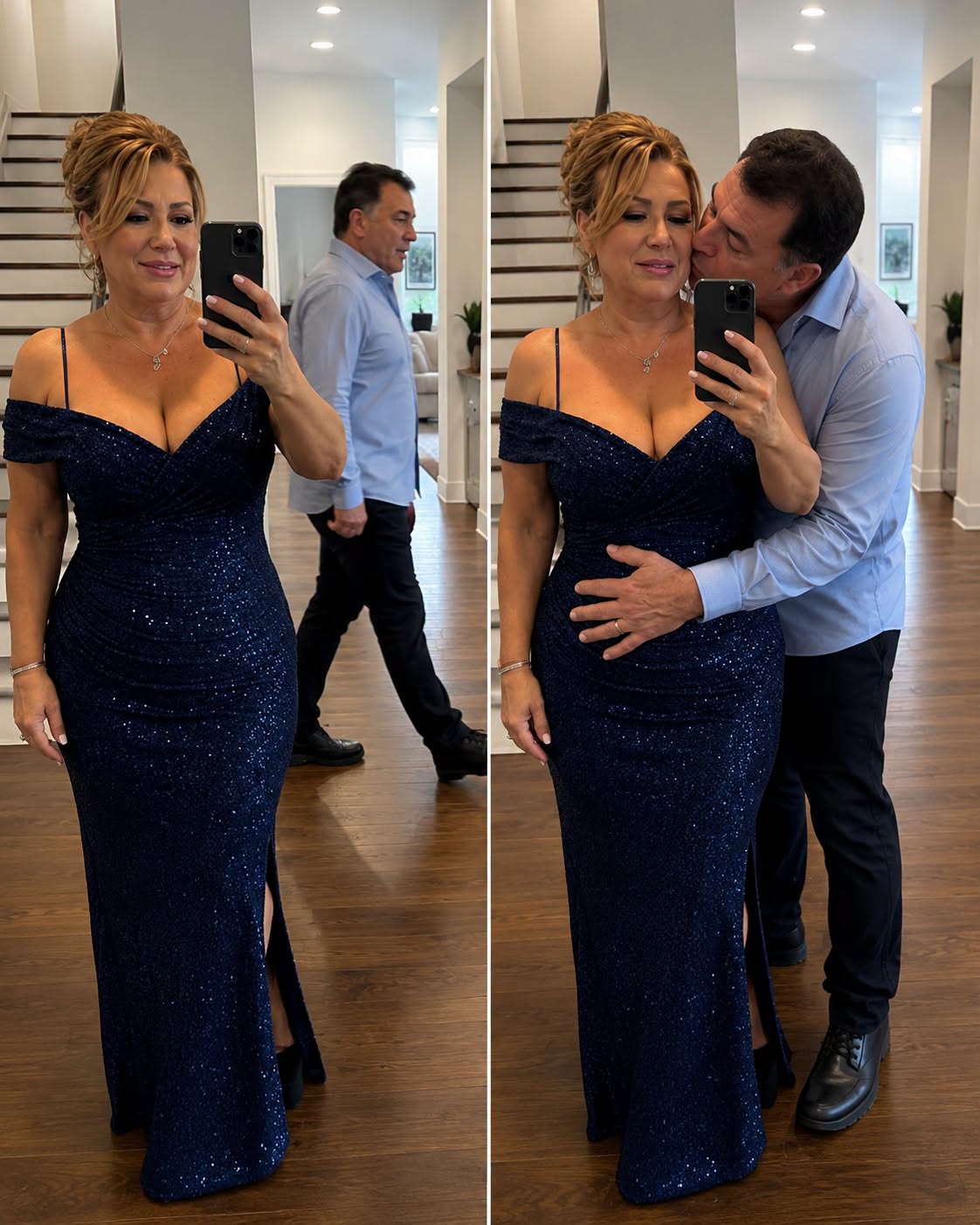
I stood on that sidewalk in my emerald green dress, mascara starting to blur beneath my eyes, watching my husband of twenty-five years cross his arms and tell me to go change or he’d leave. Behind me, through the restaurant’s front windows, I could see the warm glow of the private dining room where my three children were waiting, along with my sister, my closest friends, everyone who’d gathered to celebrate a birthday I’d been secretly excited about for months.
For one long, terrible moment, I genuinely considered turning around and driving home.
Instead, I wiped my eyes with the back of my hand, careful not to smear my makeup any further, straightened my shoulders, and walked into that restaurant alone.
I had no idea, walking through those doors, that five minutes later, my son Jake was going to stand up in front of that entire dining room and say something that would leave the whole restaurant silent, and change, permanently, the way I understood my marriage.
To understand why that emerald dress meant so much to me — why buying it had felt like such a significant, almost defiant act — you have to understand who I’d become, slowly, over twenty-five years of marriage to Damon.
I married him at twenty-five, young and hopeful, genuinely in love with a man who, in those early years, had been generous and attentive in ways that made me feel cherished. We had our first son, Jake, within the first two years of marriage, followed by our daughter, Priya, three years later, and finally our youngest son, Marcus, when I was thirty-three. I threw myself entirely into raising them, into managing our household, into supporting Damon’s career as he climbed steadily up the ladder at his engineering firm, and somewhere in the process of all that giving, I lost track of a version of myself I’d once been — a woman who used to love getting dressed up, who used to feel confident walking into a room, who used to believe, without needing convincing, that she was worth looking at.
Damon’s comments about my appearance had crept in slowly, the way these things do, so gradually that I couldn’t point to any single moment where things shifted. After Marcus was born, he made a comment about “getting back into shape” that stung more than I let on. Over the following years, the comments became a quiet, steady undercurrent — nothing dramatic enough to constitute a single, definable fight, just small, chipping remarks about my clothing choices, my weight, my “acting my age,” delivered often enough that I’d internalized them completely, until I genuinely stopped buying anything that drew attention to myself. I dressed, for the better part of two decades, in muted colors, loose fits, clothing chosen specifically to not be noticed.
Turning fifty this year did something unexpected to me. Instead of the dread I might have anticipated, I felt something closer to clarity. My youngest, Marcus, had just left for college the previous fall, meaning for the first time in twenty-seven years, our house was entirely empty of children during the day, and in that unfamiliar quiet, I found myself doing something I hadn’t done in ages: really looking at myself, thinking about what I actually wanted, rather than what I’d trained myself to accept.
I decided, in the weeks leading up to my birthday, that I wanted to do something entirely for myself. I went to a boutique downtown that I’d walked past a hundred times over the years without ever going inside, and I tried on dress after dress until I found the one — a fitted emerald green dress, elegant but undeniably eye-catching, the kind of dress that required a woman to stand up straight and own the room she walked into.
I stood in that fitting room mirror and cried, actually cried, because I looked in that reflection and saw, for the first time in years, someone I recognized. Someone confident. Someone beautiful, not in spite of turning fifty, but in the fullness of everything those fifty years had built in me.
I bought the dress without telling Damon what it looked like, wanting the reveal to be a surprise, wanting, I think, some part of me to hold onto the hope that he’d see what I saw in that mirror and be happy for me.
The evening of my birthday, I got ready slowly, savoring every part of it — carefully done makeup, hair styled in loose waves I hadn’t worn in years, the dress itself sliding on like it had been made specifically for the woman I was finally letting myself become again. I remember standing in front of our bedroom mirror, turning slightly to catch the way the fabric moved, feeling a kind of joy I genuinely hadn’t felt about my own reflection in longer than I could remember.
Damon was getting dressed in the bathroom, and when he came out in his usual navy suit, I turned to him, a little nervous, a little excited, waiting for his reaction.
He looked at me for a long moment, his expression unreadable, and simply said, “You ready to go?”
Not a word about the dress. I told myself, in the car on the way to the restaurant, that he was probably just focused on driving, that he’d say something once we arrived, once the moment wasn’t rushed. I held onto that small hope the entire drive, watching the city lights pass by, feeling that same nervous excitement I’d felt getting dressed.
We pulled up outside the restaurant — a lovely upscale place with a patio full of diners, string lights strung overhead, the kind of place I’d specifically chosen because it felt special, because I wanted this birthday to feel different from the quiet, unremarkable ones I’d had in recent years. I could see, through the window, the private dining room where our family had already gathered, could make out Jake’s tall frame, Priya’s dark hair, Marcus home from college for the occasion, all of them waiting for us.
I got out of the car, smoothing my dress, genuinely excited for the first time in longer than I wanted to admit.
Damon stopped dead on the sidewalk.
I turned back to see him staring at me, his expression shifting rapidly from neutral to something sharp and disapproving, and my stomach dropped even before he opened his mouth.
“Are you seriously wearing that?” he said, and his voice — loud, sharp, carrying easily across the patio where several diners looked up from their meals — cut through the warm evening air like something physical.
“Damon,” I said quietly, feeling heat rush to my face, aware suddenly of every set of eyes that had turned toward us. “It’s just a dress.”
“You’re fifty years old, Elena, not twenty,” he said, and I watched, with a kind of sick, dawning horror, that he genuinely wasn’t going to lower his voice, wasn’t going to spare me this humiliation in front of strangers. “Stop embarrassing me.”
I felt tears rush to my eyes immediately, hot and humiliating, standing there on that sidewalk in the dress I’d felt so beautiful in just twenty minutes earlier, now feeling exposed and ridiculous under the weight of his disapproval and the curious, pitying glances of strangers on the patio.
“Damon, it’s my birthday,” I managed, my voice cracking.
“I’m not walking in there with you dressed like that,” he said, turning his back on me entirely, crossing his arms and facing away, toward the street, like the mere sight of me had become something he couldn’t tolerate. “Go inside alone and put something else on, or I’m leaving.”
I stood there on that pavement, in a dress I’d bought specifically to feel like myself again, watching my husband of twenty-five years refuse to even look at me, and I felt something in my chest cave in completely. Diners on the patio had gone quiet, several of them clearly having witnessed the entire exchange, and I felt the full, crushing weight of humiliation settle over me — not just at what Damon had said, but at being made to feel it publicly, in front of strangers, on what was supposed to be my birthday.
For one long, terrible moment, I genuinely considered getting back in the car and driving home, canceling the whole evening, disappearing into the quiet of an empty house rather than facing another single moment of this.
But my children were inside. Jake, Priya, and Marcus had all made arrangements, taken time off, in Marcus’s case flown home from college, specifically to celebrate this birthday with me. I couldn’t disappear on them, couldn’t let Damon’s cruelty steal this evening from all four of us.
So I wiped my tears as carefully as I could manage, straightened my shoulders, and walked into that restaurant alone, leaving my husband standing on the sidewalk with his arms crossed.
The hostess, bless her, took one look at my face and gently guided me toward a small alcove near the restroom rather than straight into the private dining room, giving me a moment to collect myself.
“Are you all right?” she asked quietly.
“I will be,” I told her, and I dabbed carefully beneath my eyes with a tissue she offered, grateful for her quiet kindness in a moment when I badly needed it.
By the time I walked into the private dining room, I’d managed to steady myself enough that only the slight redness around my eyes might have given away what had just happened outside. My children rose immediately when they saw me, and I watched Jake’s face — my oldest, twenty-four now, sharp and observant the way he’d always been — shift instantly from happy anticipation to concern.
“Mom, are you okay?” he asked, crossing the room quickly. “Where’s Dad?”
“He’s coming,” I said, forcing a smile, hugging Priya and Marcus in turn, trying desperately to hold the evening together for their sake. “Just parking the car.”
I don’t think any of them fully believed me, but they let it go, for the moment, settling back into their seats, and I took my place at the head of the table, next to the empty chair where Damon would eventually sit.
He came in about five minutes later, his expression composed into something almost pleasant, greeting our children warmly, taking his seat beside me with the easy confidence of a man who believed the matter had been settled, that I’d absorbed his ultimatum the way I’d absorbed so many similar comments over twenty-five years, that we would simply move forward with the evening as though nothing had happened.
He had no idea that Jake had been standing near the restaurant’s front window when we pulled up. He had no idea that our son had watched the entire exchange unfold on that sidewalk, every word of it, through the glass.
Dinner began normally enough — appetizers arrived, conversation flowed around the table, my sister Camille, who’d joined us as well, chatted with Marcus about his classes, and for a few minutes, I actually let myself believe we might get through the evening without further incident, that I could simply hold everything together the way I’d held so many things together for twenty-five years.
But I noticed Jake had gone quiet. He’d barely touched his appetizer, his jaw tight, his eyes flicking between me and his father with an intensity that made me increasingly nervous as the minutes passed.
About five minutes into the main course, he set down his fork with a deliberate, audible click against his plate, and the small sound was enough to draw the table’s attention, conversation trailing off as everyone turned toward him.
“Dad,” Jake said, his voice carrying clearly across the table, “I want to ask you something.”
Damon, mid-bite, glanced up, still wearing that easy, composed expression. “What’s up, bud?”
“Why did you tell Mom she was embarrassing you?” Jake said. “Outside. On the sidewalk. In front of everyone on that patio.”
The table went completely silent. I felt my stomach drop, watching Damon’s expression shift rapidly from confusion to a kind of cornered alarm as he registered what Jake was actually asking.
“I don’t know what you’re talking about,” Damon said, his voice carrying a forced lightness that didn’t quite land.
“I was standing by the window when you pulled up,” Jake said, his voice steady, unrelenting. “I heard everything, Dad. I watched you tell Mom she was fifty, not twenty, like that was some kind of insult. I watched you turn your back on her and tell her to go change or you were leaving. I watched her stand there crying on a public sidewalk on her own birthday.”
Priya’s hand flew to her mouth. Marcus, still young enough that I could see the shock hit him in real time, looked between his father and me with an expression of genuine, wounded disbelief.
“You did that?” Priya asked quietly, turning to Damon. “Dad, is that true?”
“It’s not— that’s not exactly what happened,” Damon started, glancing around the table, clearly registering, for the first time, that he’d walked into this dinner without any idea his humiliation of me had an eyewitness sitting right there among our children.
“So you didn’t tell Mom she was embarrassing you?” Jake pressed. “You didn’t refuse to walk in with her? You want to sit here and tell me I imagined all of that, standing right there at that window?”
Camille, my sister, had gone very still, watching this unfold with an expression of quiet, gathering fury I recognized well from our childhood, the particular look she used to get right before she stood up for me against anyone who dared cross a line.
Damon set down his own fork, his composure fully cracking now, color rising in his face. “Jake, this isn’t the time or place—”
“It’s Mom’s fiftieth birthday,” Jake said, his voice rising slightly now, though he kept himself controlled, deliberate, clearly having thought through exactly what he wanted to say. “You made it about your embarrassment, in public, on the sidewalk, before we even sat down. I think this is exactly the time and place.”
I sat there, frozen, watching my twenty-four-year-old son do something I had never, in twenty-five years, managed to do myself — hold Damon accountable, directly, unflinchingly, in front of witnesses, without softening it or apologizing for taking up the space to say it.
“Mom,” Jake said, turning to me now, his expression softening considerably, “you look beautiful tonight. That dress is stunning. You deserve to feel exactly as confident as you looked walking in here, and it makes me furious that anyone, especially Dad, made you feel anything less than that on your own birthday.”
I felt tears rising again, but different tears this time — not the humiliated, defeated tears from the sidewalk, but something else entirely, something warm and overwhelming, watching my son stand up for me with such total, unhesitating clarity.
“Jake,” Damon said, his voice tight now, embarrassment curdling visibly into anger, “that’s enough.”
“Is it?” Jake said, and something in his voice made even Damon pause. “Because I’ve been thinking about this for years, actually, Dad. I’ve watched you comment on Mom’s clothes, her weight, what she eats, for basically my entire life. I always told myself it wasn’t my place to say anything, that it was between the two of you, that maybe I was misreading it. But watching you do it tonight, in public, on her fiftieth birthday, made something click for me that I think I’ve been avoiding facing for a long time.”
Priya spoke up now too, her voice shaking slightly but determined. “He’s right, Dad. I remember — I remember so many times, growing up, watching you say things to Mom about how she looked, and watching her just… go quiet. Change her outfit. Apologize, even, sometimes, for something she was wearing that you didn’t like. I always thought that was just how marriages worked. I didn’t understand, until right now, actually watching it happen in front of me, how messed up that actually is.”
Damon looked around the table, and I watched something shift in his expression — the composed, confident man who’d walked in five minutes earlier now looking genuinely, visibly rattled, searching the faces of his own children for some kind of support and finding, instead, three sets of eyes regarding him with a mixture of disappointment and, in Jake’s case, open anger.
“I was just being honest,” Damon said, though his voice had lost most of its earlier certainty. “The dress was— it wasn’t appropriate for a woman her age. I wasn’t trying to hurt anyone, I just—”
“Dad.” Marcus, the youngest, spoke for the first time, his voice quiet but clear enough to cut through Damon’s justification entirely. “There is no age where Mom stops being allowed to feel beautiful. I don’t understand how you don’t see that.”
The table fell silent again, and I noticed, glancing around, that the silence had extended beyond our own party — several tables in the main dining room, visible through the open doorway of our private space, had gone quiet too, diners clearly having caught at least the tail end of what was unfolding, several of them not even pretending not to listen anymore.
I want to be honest about what I felt, sitting there in that silence, watching my children hold their father accountable in a way I had spent twenty-five years failing to do myself. Part of me felt an overwhelming, aching pride — pride that I had somehow, despite everything, raised children who could see clearly, who could name cruelty when they witnessed it, who loved me enough to say something even when it meant confronting their own father in a room full of witnesses.
But another part of me felt something closer to grief — grief for all the years I had absorbed comments just like the one on that sidewalk without ever once standing up for myself the way my children were now standing up for me. Grief for the version of myself who had genuinely believed, for a very long time, that Damon’s comments were simply the price of a peaceful marriage, that swallowing my own hurt was somehow a form of love rather than a slow, steady erosion of everything I used to be.
I finally spoke, my voice steadier than I expected, cutting through the heavy silence that had settled over the table.
“Thank you,” I said, looking at each of my children in turn. “All three of you. I don’t think I realized, until just now, how much I needed to hear that.”
Damon reached for my hand under the table, his expression shifting into something pleading now, clearly registering that this evening had gone somewhere he hadn’t anticipated and desperately searching for a way to recover it.
“Elena, I’m sorry,” he said, his voice lower now, quieter, aimed more at me directly than at the table at large. “I shouldn’t have said what I said. Not like that, not in public.”
“Not like that,” I repeated slowly. “Damon, would it have been acceptable privately? Would it have been fine if you’d waited until we got home to tell me I was too old for this dress, that I was embarrassing you by wanting to feel beautiful on my own birthday?”
He didn’t have an answer for that. I watched him search for one, his mouth opening slightly and then closing again, and I felt, for the first time in longer than I could remember, that I was seeing my husband clearly — not through the lens of twenty-five years of accumulated compromise and self-diminishment, but plainly, as he actually was in that moment.
“I bought this dress,” I continued, my voice steady now, gaining strength with every word, “because for the first time in years, I looked in a mirror and saw someone I actually recognized. Someone confident. Someone who felt beautiful, not despite turning fifty, but because of everything those fifty years have given me — three incredible children, a career I’m proud of, friendships I treasure, a whole life I built alongside raising this family. And you looked at that woman, on the happiest night I’d had in years, and the only thing you could think to say was that she was embarrassing you.”
The restaurant, I realized, had gone almost entirely silent now, servers pausing near the doorway, other diners no longer even pretending to focus on their own meals. I felt a flush of self-consciousness at the audience, but something steadier underneath it too — a sense that I had absolutely nothing to be ashamed of in this moment, that whatever embarrassment belonged in that room belonged entirely to the man sitting beside me.
“I think,” I said quietly, “that you’ve spent twenty-five years training me to make myself smaller. Smaller clothes, smaller opinions about how I look, smaller everything, so that you never had to feel challenged by having a wife who took up space, who felt confident, who turned heads for reasons that had nothing to do with your approval. And I let you, Damon. For twenty-five years, I let you, because I told myself it was easier, that it kept the peace, that it was what a good wife does.”
“Elena—” he started.
“I’m not finished,” I said, and something in my voice must have carried enough finality that he actually stopped, waiting. “Tonight, my son had to say the thing I should have been saying to you for years. That stings, Damon. It stings to realize that a twenty-four-year-old had more courage in five minutes than I managed to summon in twenty-five years of marriage. But I’m grateful for it. I’m grateful that our children see clearly, even when their mother spent years not seeing clearly enough herself.”
The rest of that dinner unfolded in a strange, charged atmosphere — Damon largely silent, chastened, occasionally attempting some small gesture of reconciliation that I met with polite but unmistakable distance. My children, by contrast, seemed to relax as the evening continued, as though some long-held tension in the family had finally, publicly, been named and could no longer be quietly ignored the way it always had been before.
Camille pulled me aside near the end of the evening, in the small hallway near the restrooms, and hugged me tightly.
“I’ve wanted to say something to him for years,” she admitted quietly. “I never felt like it was my place. Watching Jake do it tonight — Elena, I’m so proud of that boy. And I’m proud of you too, for finally saying the rest of it yourself.”
I drove home that night separately from Damon, having asked Jake to drop me off instead, needing space I hadn’t fully realized I needed until the option presented itself. Damon called twice that evening; I let both calls go to voicemail, needing time to sit with everything that had happened before I was ready to have any further conversation with him about it.
The weeks that followed were difficult, in the particular way that necessary conversations often are. Damon and I talked — really talked, more honestly than we had in years, about the pattern of comments that had shaped so much of our marriage, about the ways I had shrunk myself to accommodate his insecurities, about whether the marriage itself could survive an honest reckoning with all of it. I won’t pretend those conversations were easy, or that they resolved everything neatly. Twenty-five years of accumulated patterns don’t unravel over a few weeks of hard conversations, however honest.
But something did shift, permanently, after that birthday dinner. I started wearing the colors and cuts I actually wanted to wear, without asking Damon’s opinion first, without bracing myself for a comment that, for the first time in years, mostly stopped coming — whether from genuine growth on his part or simple, chastened self-preservation, I genuinely couldn’t say with certainty, and honestly, I decided it didn’t matter as much to me as it once might have. I had stopped needing his approval to feel confident in my own reflection.
I wore that emerald green dress again, a few months later, to my niece’s wedding, and I felt exactly as beautiful in it the second time as I had the first — this time without a single comment from anyone, this time simply enjoying the evening, dancing with my children, feeling entirely, uncomplicatedly like myself.
Damon and I are, as of this writing, still working through what our marriage looks like going forward. Some days feel genuinely hopeful — moments where I see real, effortful change in how he speaks to me, real reflection on the pattern he’d built over twenty-five years without, I think, ever fully examining it. Other days, I find myself wondering whether twenty-five years of a particular dynamic can ever be fully rebuilt into something healthier, or whether some foundations, once cracked deeply enough, simply can’t bear the same weight they once did.
What I know for certain is this: I will never forget the sound of my son’s voice cutting through that dinner table silence, asking his father, plainly and without flinching, why he’d told his mother she was embarrassing him. I will never forget the way that question landed in that room, the way it gave me, finally, permission to say everything I’d swallowed for twenty-five years.
Some people, hearing this story, might say I handled it wrong — that I should have confronted Damon myself, immediately, rather than letting my son do it for me. Maybe that’s true. But I think there’s something worth honoring, too, in what it means to raise children who see injustice clearly enough, and love you fiercely enough, to name it out loud when you yourself have lost the words.
I turned fifty this year in a dress that made me feel like myself again, for the first time in longer than I want to admit. And though the evening didn’t unfold the way I’d hoped when I first put it on, I think, in the end, it gave me something far more valuable than a pleasant birthday dinner ever could have.
It gave me back my own voice, borrowed briefly through my son’s, until I found the courage to use it myself.


