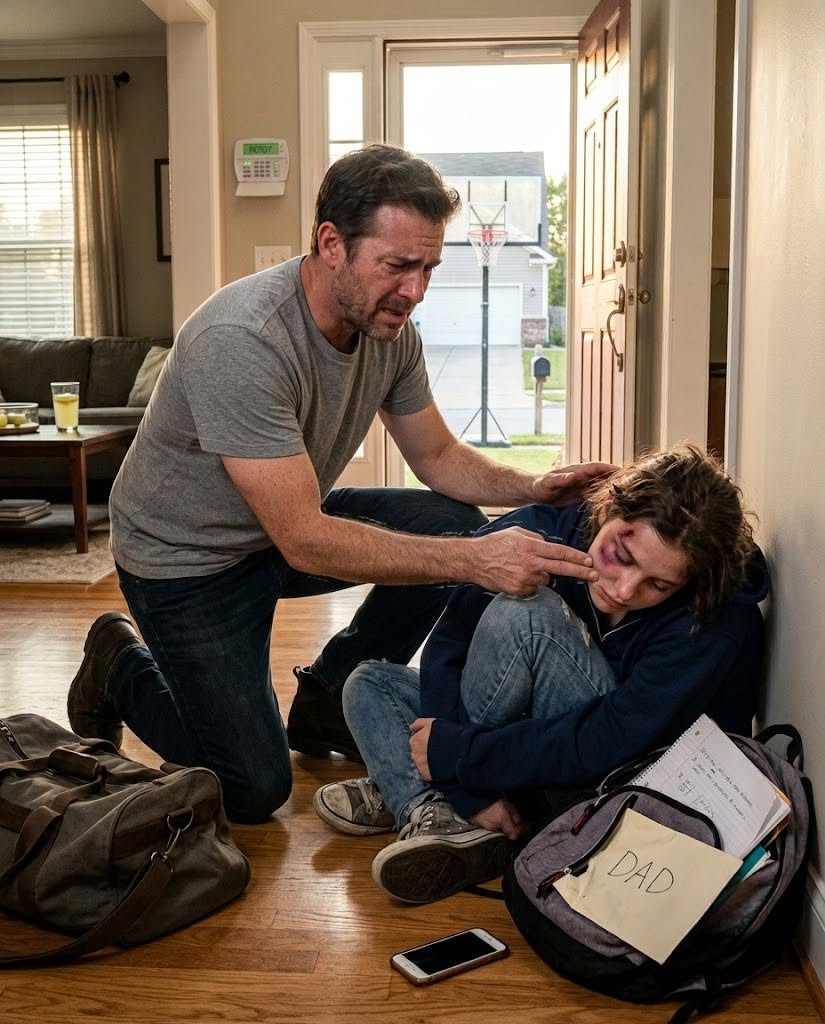
For a moment, I thought pain had scrambled her words. Harper was my wife—the woman who had promised to protect Violet while I was away.
Sirens rose outside before I could ask another question. Paramedics moved me back only far enough to work, and I kept one hand where Violet could feel it while they stabilized her neck and lifted her onto the stretcher.
At the hospital, a police officer repeated the word robbery. A laptop was missing, the front door had been open, and Violet could barely speak. I listened without arguing because arguing would not help her.
Then I opened the backpack.
The cream envelope marked DAD was not a birthday card. Inside were printed bank statements from Violet’s education account, three withdrawals circled in blue ink, and a note in her handwriting: Dad, I tried to tell Harper I saw the transfers. She said you would never believe me.
The account receiving the money ended in the same four digits as Harper’s personal checking account.
That was when Harper rushed into the waiting area.
She did not ask whether Violet was awake. She did not ask what the doctors had said.
Her eyes went straight to the backpack on my lap.
“Give me that,” she said.
I folded the statements once and kept them in my hand. “Why?”
Harper stopped two steps away. Her face tightened, but her voice dropped into the careful tone she used whenever she wanted a room to believe she was the calm one.
“Because Violet stole private financial records,” she said. “You don’t understand what she did.”
Behind her, the officer turned slightly so he could hear every word.
I set the backpack on the chair beside me but kept my hand on the strap.
“Then explain it,” I said.
Harper looked at the officer, looked at the envelope, and made the mistake that changed the entire case.
She said, “The boys were only supposed to get the copies back.”
I did not move.
The officer asked the question I was already holding back. “What boys?”
Harper stared at him as if she had forgotten he was there. Then she tried to pull the sentence back into something harmless.
“My son and his friend,” she said. “They went to talk to her. That is all.”
Harper’s son was twenty-one, old enough to know better and young enough to believe his mother could clean up whatever he broke. He had stayed with us twice during my last deployment and knew which kitchen cabinet held the spare batteries, where Violet kept her school schedule, and how our house sounded when no one else was home.
I asked Harper how they got inside.
“Violet let them in.”
The answer came too quickly.
The officer asked whether Harper had told them Violet would be alone.
Harper’s eyes flicked toward the double doors leading to the treatment rooms. “I told them she would be home. I did not tell anyone to hurt her.”
The officer did not accuse her. He simply asked whether she had contacted them that afternoon.
Harper reached for her phone.
That was her second mistake.
She opened a message thread as if she could prove innocence by choosing which part of the truth we were allowed to see. The top message said, Talk to her. Get the papers. Do not let her make this bigger.
Below it was a reply from her son: She locked herself in the hall bathroom.
Harper had answered: Then use the code and wait her out. I need every copy before he gets home.
The officer asked to see the time.
3:18 p.m.
I had stepped out of the rideshare at 4:06.
Harper snatched the phone back and said the message sounded worse than it was. She claimed Violet had copied statements without permission and threatened to destroy the family over a misunderstanding.
I looked at the circled withdrawals.
The first had been made six weeks earlier. The second came three days after I wired money for Violet’s summer program. The third had emptied nearly everything left in the account.
There was no misunderstanding in the arithmetic.
“What was the money for?” I asked.
Harper folded her arms. “Household expenses.”
“Our mortgage is automatic.”
“Then repairs.”
“There are no repair invoices.”
Her jaw shifted.
The officer told her not to leave the waiting area while he contacted the investigator assigned to the house. He did not arrest her, threaten her, or deliver a speech. He just changed the room in one practical way: Harper was no longer speaking as my wife trying to manage a family problem. She was speaking as a person whose own words had placed two men inside my home.
A nurse came through the doors and said Violet was being taken for imaging. She was stable enough for me to see her for a minute before they moved her.
I stood.
Harper stepped into my path. “You cannot go in there and fill her head with your version.”
The officer moved closer, but I raised one hand—not at Harper, not in anger, simply between us.
“She already gave me hers.”
Harper’s mouth opened.
I walked around her.
Violet looked smaller in the hospital bed than she had in the hallway. A brace held her neck still, one eye was swollen, and the bruising along her cheek had deepened under the bright exam lights.
Her fingers moved against the blanket when I came near.
“I’m here,” I said.
She tried to apologize.
That hurt more than anything Harper had said.
“I should have told you sooner,” Violet whispered.
“You told me now.”
“She said you would think I was trying to ruin your marriage.”
I pulled the chair close and sat where she could see me without turning her head. “You do not have to protect my marriage from the truth.”
Her eyes filled, but she did not cry. She looked toward the door instead, listening for Harper’s voice in the hallway.
I asked whether Harper’s son had hit her.
Violet closed her eyes for a moment.
“He wanted the envelope,” she said. “I told him it was already mailed.”
It was a lie she had used to buy time.
The copies were still in her backpack, but Harper’s son had believed there might be another set beyond his reach. That was why the living room had stayed neat and the backpack had been torn open. They were not stealing valuables. They were searching for paper.
Violet said the friend blocked the front door while Harper’s son demanded the envelope.
When she tried to run toward the neighbor’s house, they pulled her back into the hall.
She remembered falling against the wall. She remembered the backpack sliding from her shoulder. She remembered one of them saying they had to leave before I came home.
Then her memory broke into pieces.
I did not ask her to force it back together.
A doctor entered, explained that Violet needed close observation, and told me the next several hours mattered. I signed only what was necessary and stayed beside her until medication pulled her into sleep.
Outside, Harper was gone from the waiting area.
The officer had not released her. She had walked away while he was on the phone.
For one second, every instinct in me demanded movement.
I knew the roads she would take. I knew where her son usually stayed. I knew how quickly anger could disguise itself as duty.
Then Violet’s hand tightened weakly around two of my fingers.
That decided it.
I stayed.
The war I had imagined on the hallway floor would not be fought in a parking lot or behind a locked door. It would be fought by keeping Violet alive, preserving what she had risked herself to save, and refusing to let Harper turn my absence into an excuse for what she had done.
I called the alarm company from the chair beside Violet’s bed.
I did not ask for an investigation. I asked for the activity history on my own account and requested that all existing codes be frozen except mine until I could verify access.
The representative confirmed that the system had been disarmed at 3:21 p.m. using Harper’s personal code.
It had not been turned off by Violet.
It had not malfunctioned.
Harper had opened the house for them from wherever she was, then relied on the open door and missing laptop to make the scene look like a robbery.
The laptop mattered because it held the original account downloads.
The birthday envelope mattered because Violet had printed copies when she realized digital files could disappear.
The green READY light had not meant our home was secure. It meant the people who hurt her had been allowed through every protection I thought I had built.
Near midnight, the investigator returned.
Harper’s son and his friend had been located separately. I was given no dramatic details, only the facts that mattered: both had been identified, neither was coming back to the house that night, and the missing laptop had been recovered.
The investigator asked whether Harper had permission to move money from Violet’s education account.
“No.”
He asked whether Harper knew the alarm code used that afternoon.
“It was hers.”
He asked whether Violet had ever given me reason to believe she would stage an attack or falsely accuse Harper.
I looked through the glass at my daughter asleep beneath a hospital blanket.
“No.”
The investigator collected the statements and photographed the envelope before sealing them with the laptop as part of the case. I kept Violet’s handwritten note only after he documented it and told me it could stay with her personal property.
Harper called me at 12:43 a.m.
I answered because I wanted her next choice to be hers.
She began with tears. Then blame. Then money.
She said her son had debts and had been afraid. She said she had borrowed from Violet’s account only temporarily. She said Violet had embarrassed her by keeping records. She said the boys panicked when Violet screamed.
Finally, she said the sentence that stripped away every excuse.
“I needed the papers gone before you got home.”
Not before someone misunderstood.
Not before Violet made a mistake.
Before I got home.
I asked whether she had known they were in the house.
She was silent long enough to answer.
Then she said, “I knew they were going to scare her. I did not know they would take it that far.”
The investigator, standing several feet away, could hear only my side of the call. I told Harper clearly that I was not alone and that she should speak directly with the officer assigned to the case.
She hung up.
I did not call back.
By morning, Violet was awake for longer stretches. The doctor said her injuries were serious but treatable, and that recovery would take time.
Harper tried to send a message through a relative, saying she wanted to visit and explain.
I gave the same answer each time: Violet would decide if and when she wanted contact, and until she could make that choice freely, Harper would have none.
That boundary cost me.
Harper’s name was on bills, household accounts, and half the routines I had allowed her to carry while I was gone. Untangling those things meant forms, calls, missed sleep, and admitting how much I had trusted convenience over verification.
It also meant confronting a fact I wanted to reject.
Harper had not become dangerous in one afternoon.
Violet had been trying to warn me in smaller ways for months.
She had asked why account alerts went to Harper’s email. She had mentioned that Harper checked her backpack. She had once asked whether I could call when Harper was not in the room.
I had heard each question as a separate inconvenience because I was far away and desperate to believe the house was functioning.
Harper had used that distance.
She had not needed to convince me Violet was dishonest. She only needed to make every concern sound too small to interrupt a deployment, a briefing, or another promise that I would deal with it when I got home.
That was the betrayal beneath the assault.
The first betrayal was Harper’s.
The second was the way my absence had taught Violet to ration the truth so I would not feel guilty.
I could not undo either one with rage.
On Violet’s sixteenth birthday, she was still in the hospital.
I brought no balloons and made no speech. I brought her soft socks, the lemon candy she liked, and the charger she had complained I always forgot.
A nurse allowed me to place one small cupcake on the tray, but Violet was too nauseated to eat it.
She looked at the cream envelope on the bedside table.
“I ruined your surprise,” she said.
I shook my head. “You gave me the truth.”
She studied my face as if she expected the old answer—the one where I told her everything would be fine and then returned to work.
Instead, I told her what I had already done.
Harper’s access to the house had been removed.
All financial permissions connected to Violet’s account were frozen.
A trusted adult would stay with Violet whenever I had to leave the room.
And I had requested emergency leave long enough to bring her through the first stage of recovery.
I did not promise I would never miss another birthday. People who live my life learn not to make promises the world can break for them.
I promised something narrower and harder.
“When you tell me something is wrong, I will not make you prove it alone.”
Violet turned her face toward the window.
After a moment, she said, “Okay.”
It was not forgiveness.
It was permission to begin earning trust again.
Harper eventually spoke through an attorney, but the story she offered kept changing.
First, she had sent the boys only to talk.
Then she had sent them to retrieve stolen documents.
Then she admitted she had given them the alarm code but claimed she thought Violet would cooperate.
The alarm activity, her messages, the recovered laptop, the bank records, and Violet’s account all pointed in the same direction. The authorities did not need me to hunt anyone. They needed me not to contaminate the truth with my anger.
Harper’s son tried to place most of the blame on his friend.
His friend said Harper’s son had promised him cash and told him the homeowner was overseas.
Neither explanation made Violet less injured.
Neither changed who had opened the door.
Weeks later, Violet came home with a fading bruise near her eye and a careful way of walking when she was tired.
The hallway floor had been cleaned, but the cream envelope had a permanent crease where the backpack zipper crushed it.
I offered to replace it.
She said no.
We sat at the kitchen table while the alarm technician reset the system. He removed every old code and asked us to choose new ones.
I looked at Violet.
“You first.”
She entered a number I did not watch.
That mattered.
The old system had treated access like something adults controlled around her. The new one gave her a code that belonged only to her, and she could change it whenever she wanted.
I entered mine after she stepped away.
When the technician left, the keypad glowed green again.
READY.
For several seconds, neither of us said anything.
Then Violet picked up her backpack and carried it down the hallway without asking me to walk beside her.
I let her go at her own pace.
The case did not end that day. There were interviews, hearings, medical appointments, and bills that arrived in envelopes too ordinary for what they represented.
Harper never returned to the house.
Whether Violet ever speaks to her again will be Violet’s decision, not mine.
My own anger did not disappear. It became something I had to manage with the same discipline people had once praised in more dangerous places.
The sentence in my head that afternoon—Traitors will die tonight—did not become a body count.
It became the end of Harper’s access, the end of her control over Violet’s money, and the end of the story she had built around my absence.
Months later, Violet returned to school part time.
On the first morning, I made toast too dark, packed more food than she could eat, and checked the front lock twice.
She rolled her eyes.
It was the most beautiful ordinary thing I had seen in years.
Before she left, she placed the cream envelope in the drawer where we kept important papers.
Not hidden in a backpack.
Not crushed beneath a zipper.
Then she tapped the alarm code with one hand, waited for the soft confirmation tone, and looked back at me.
“Ready?” I asked.
She nodded toward the door.
This time, the green light meant exactly what it was supposed to mean.


