Ten minutes after my divorce hearing began, my husband smiled at me across the courtroom in Charlotte, North Carolina, as if he already knew how everything would end.
His name was Graham Ellison—polished, precisely assembled, the kind of man who understood that appearance was its own argument. Perfect navy suit. Perfect posture. The particular self-assurance of someone who has spent a career walking into rooms and watching people decide to trust him before he finished his first sentence.
He stood beside his attorney, adjusted his cufflinks with the unhurried confidence of a man who has no concern about outcomes, and asked the judge for half of everything I owned.
Not just the house in Dilworth where we had lived together for four years. Not just the joint accounts we had opened during the marriage. He wanted half of my company—a private technology firm I had built over eight years from a rented desk in a shared workspace into a business with thirty-one employees and a current valuation of twelve point four million dollars—and he wanted access to the trust my father had established for me years before Graham Ellison had ever heard my name.
Dictionaries& Encyclopedias
I watched him speak.
Behind Graham, in the gallery, sat my mother Patricia and my younger sister Brooke, side by side in a row they had chosen carefully—directly in my sightline, close enough that I would know they were there. Brooke’s husband Camden was beside them, leaning forward slightly with the attentiveness of someone watching a sporting event they have money on.
They were not hiding their satisfaction.
Graham’s attorney described the requests as “fair and reasonable.” Graham looked at me across the room with the expression of someone who has been waiting for this particular moment for longer than the proceeding implied.
“Claire has always controlled the money,” he said smoothly. “I am only asking the court to correct the imbalance.”
I looked at my hands, folded on the table.
Nathaniel Brooks, my attorney, sat beside me. He had told me that morning, over coffee in his office on South Tryon Street, to let Graham speak first. People reveal the most when they believe they’re winning, he’d said. Let him hand us the rope.
So I let him speak.
I let him call my financial boundaries selfish. I let him describe my father’s trust as something I had “used to benefit the marriage,” which was a creative construction that bore no relationship to the actual history of what I had done with my father’s trust. I let him suggest that my company’s growth had been supported by his legal advice, though the legal advice he had actually provided consisted of reviewing two vendor contracts in 2021 and sending me, unrequested, his analysis of a competitor’s trademark filing that had no relevance to our operations.
I let my mother and sister sit behind him and look at me like they believed they had chosen correctly.
And while all of this happened, the sealed envelope sat in front of me on the table, exactly where I had placed it when I sat down.
My father’s name was Richard Ellsworth Rowland, and he was the kind of man who read people the way other people read weather—with attention, without judgment, with the practical interest of someone who needs accurate information to make good decisions.
He had built his money slowly, in the way that things built slowly tend to be more durable. Commercial real estate in Charlotte, starting in the early eighties when the city was becoming something different from what it had been, when people with patience and capital and an accurate read of where the growth was heading could position themselves well. He was not flashy about it. He drove the same truck for twelve years. He wore the same watch at seventy that he had worn at forty. He donated quietly to institutions he believed in and never required his name on the building.
He told me once: Money is a tool. Like any tool, it reveals character in the person who holds it.
What he meant, I understood later, was that it reveals character in everyone around the person who holds it.
After he died—pancreatic cancer, fourteen months from diagnosis to the end, during which time he remained more himself than most people manage in ordinary health—his will was read at the offices of his estate attorney. My mother received the house in Myers Park and a generous cash inheritance. Brooke received a similar cash amount and the lake property in Mooresville that she had always loved.
To me, he left the trust.
The trust was significant. It was not an accident that it was significant. My father had been watching for the better part of a decade, and he had seen what I was building, and he had made a decision that he expressed not in words—he was not a man who made grand speeches about his intentions—but in the specific configuration of an estate plan that told you everything about what he believed.
He also left me a letter, separate from the legal documents, which I read in the car in the parking garage outside the attorney’s office and which I have kept since in the fireproof box in my home office alongside the documents that matter most.
The letter said, among other things: You will know who is on your side by watching what they do with the information. The ones who are glad for you will be glad. The ones who were always counting will start counting.
Within three months of the will being read, my mother had begun suggesting that my father had made a mistake—not to me directly, but to Brooke, who told me with the breathless energy of someone delivering information they find important. “Mom thinks Dad didn’t think it through properly,” Brooke said. “She thinks he would have wanted things split more evenly.”
What my mother meant was that she would have preferred more money.
What Brooke meant was the same thing, expressed differently.
I did not argue about it. My father had thought it through with great care, and he had made his decision, and no amount of retroactive family opinion changed the legal reality of the trust.
What I did not yet understand was that this was the beginning of an alignment—my mother, my sister, and eventually my husband moving toward the same position by slightly different routes.
Graham and I had been introduced at a professional event in 2018 through a mutual acquaintance who worked in corporate law. Graham was a partner at a mid-sized firm in Charlotte, specializing in business litigation. He was thoughtful in conversation, funny in a dry way that I found more interesting than performed humor, and he asked questions that suggested he was actually listening to the answers.
We were married in 2020, a small ceremony because of the pandemic, which in retrospect I understood as having given us less of the examination that a larger event would have required.
The questions about my finances began before the wedding, which I noted and misread.
A man who is interested in building a life with you, I told myself, is naturally interested in the practical dimensions of that life. Questions about the trust structure, about the company’s ownership configuration, about whether the family holdings were part of my personal assets or structured separately—these could be due diligence from a lawyer who thought carefully about financial risk. I chose to read them that way.
I was wrong.
The questions after the wedding became more specific. He wanted to review the trust documents directly. He wanted to understand, as he put it, “the full picture of our household assets.” He suggested, once, that keeping the trust assets entirely separate from our marital finances was “a signal of distrust” that he found hurtful.
He said this gently, with the professional precision of someone who knows how to deliver an argument in a way that is difficult to refuse without appearing unreasonable.
I did not give him access to the trust documents.
I did not fully understand, at the time, why I was holding the line. It was instinct as much as analysis—the specific instinct of someone who has been taught by her father to watch what people do with information.
What I noticed was that after each conversation in which I declined to give Graham more access, he would have dinner with my mother and sister within the week. The dinners had been framed, early in our marriage, as his effort to maintain family relationships independently. I had thought this was charming.
I revised that interpretation.
The tablet came later.
He had left it in the guest room, plugged into a charger he had apparently forgotten was there, still connected to a secondary email account I had not known about. I was looking for an adapter when the screen illuminated.
The message was from Tessa.
Tessa Hartwell, Brooke’s closest friend since college. Tessa, who had been to my home for Thanksgiving and Christmas and an Easter brunch that Sarah had organized. Tessa, who had once told me, with what had appeared to be genuine warmth, that she hoped Graham and I lasted forever.
The message on the tablet said: She still doesn’t know. Just keep her calm until the filing is done.
I stood in the guest room for a long time.
Then I did what my father had taught me to do with important information: I was quiet with it. I did not react immediately. I did not confront Graham that night or any night. I took a photograph of the screen with my personal phone. I noted the date and time. I thought carefully about what I knew and what I needed to find out.
Three days later, I called Nathaniel Brooks.
Nathaniel Brooks had represented me on a contract dispute four years earlier, and his value in that situation had been less his legal knowledge, which was considerable, than his temperament—he did not escalate, he did not perform outrage, he moved precisely and let the facts do the work. He had told me, when we first met, that the best legal outcomes came from clarity rather than noise.
I told him everything.
The tablet. The message. The pattern of questions about the trust. The dinners with my mother and sister. The specific ways Graham had tried, over four years, to position himself closer to assets that were not marital property.
Nathaniel listened without interrupting.
Then he asked two questions.
“Have you accessed any of his devices, accounts, or documents in a way that could be characterized as unauthorized?”
“No. The tablet was in a shared room, on, displaying an open message.”
“Good. And do you have any reason to believe he has already taken any legal action?”
“The message mentioned ‘the filing.’ I don’t know what that refers to.”
“We’ll find out,” Nathaniel said. “In the meantime, you continue your normal routine. You say nothing to Graham, your mother, your sister, or Tessa. You document anything relevant that occurs naturally—conversations, requests, behaviors. You do not seek out information, but you record what comes to you.”
He paused.
“He’s going to file first,” Nathaniel said. “He wants to control the narrative from the start. So we’re going to let him file, and then we’re going to be very ready.”
“What are we building?”
“The complete picture,” Nathaniel said. “Which he doesn’t know we have.”
Over the following six weeks, with Nathaniel’s guidance and the assistance of a forensic financial analyst named Dr. Patricia Voss who had testified in dozens of complex asset cases, we built the complete picture.
Graham filed for divorce on a Tuesday morning in February.
He had timed it, Nathaniel believed, with the intention of catching me unprepared—the assumption being that I would not have legal counsel in place, that I would be in the emotional state of someone who has just been blindsided, and that in that state I would make decisions that would benefit him.
Nathaniel called me within an hour of the filing notification.
“You knew?” I asked.
“I suspected the timeline,” he said. “We’ve been ready for three weeks.”
What we had built in those three weeks was this: a complete documentation of the trust’s history, demonstrating unambiguously that every asset in the trust had been established before my marriage to Graham and had been maintained in strict separation throughout—no commingling, no transfers that could be characterized as marital, no usage for joint purposes that could support a claim of contribution. Dr. Voss had reviewed every transaction in the trust’s history and prepared a report that Nathaniel described as “bulletproof.”
We also had the documentation of my company’s development: the chronology of its growth, the financial records from the early years, the contracts and the payroll records and the product development timeline—all of which demonstrated that the company had been built through my own work, risk, and capital, beginning years before Graham was part of my life.
And we had the message from Tessa’s tablet.
We also had something else. Something Nathaniel had found through legitimate discovery channels, which Dr. Voss had identified and documented with her characteristic precision.
That was what was in the sealed envelope.
“The court recognizes Nathaniel Brooks for the respondent,” Judge Frances Okafor said.
She was a small woman with an authoritative stillness that communicated, without words, that proceedings in her courtroom ran at her pace and no one else’s. She had reviewed the preliminary filings and had the measured expression of someone who has read more than the parties realize.
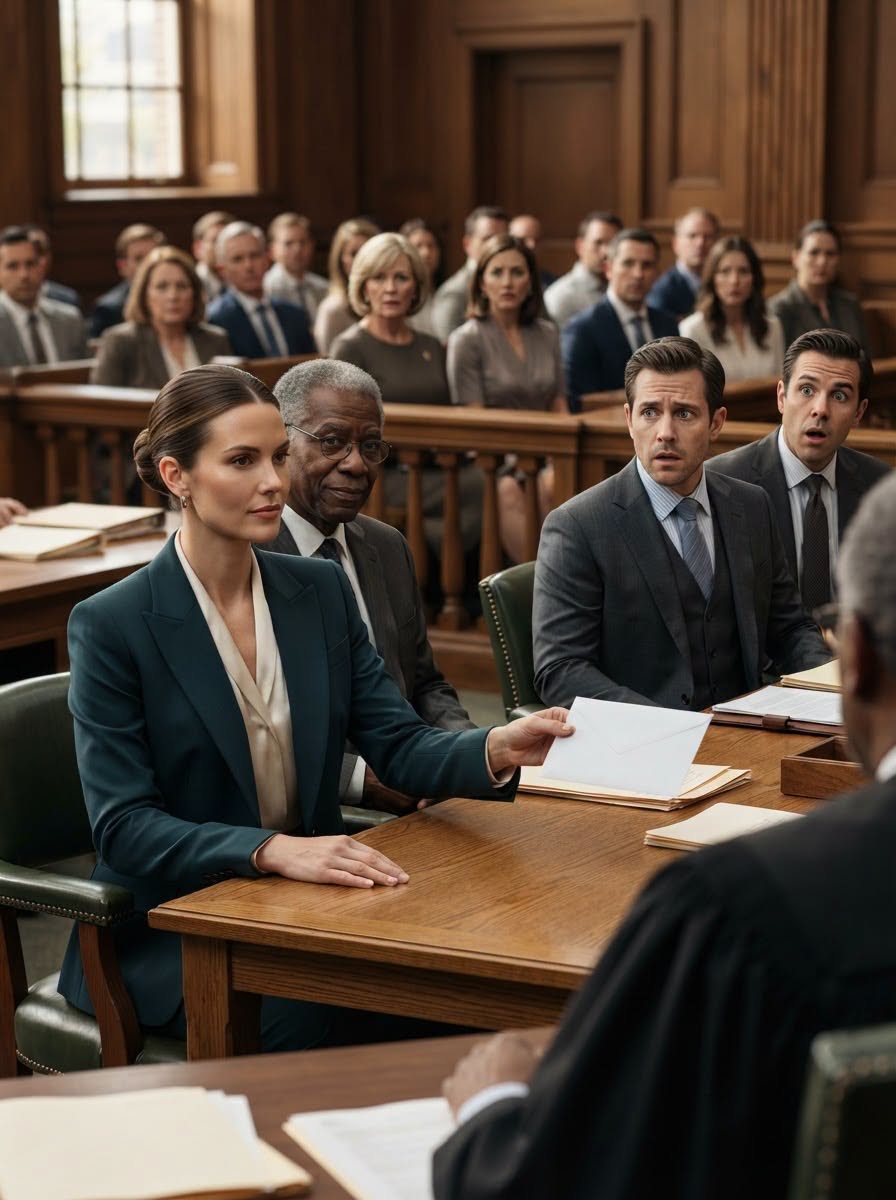
“Thank you, Your Honor,” Nathaniel said. He remained seated, which was a choice. “Before I respond to the petitioner’s claims, I’d like to submit an exhibit for the court’s review.”
He nodded to me.
I slid the sealed envelope across the table to the clerk.
Graham’s attorney—a man named Phillip Hartwood who had the aggressive efficiency of someone who prefers to win before the other side organizes—looked at the envelope with the attention of someone who has not expected it. Graham himself glanced at it. His expression did not change, but something in the set of his shoulders shifted.
Judge Okafor opened the envelope.
She read.
She read for longer than I had expected, turning pages with the unhurried attention of someone who is not going to be rushed.
The room was quiet.
Nathaniel sat beside me with his hands folded on the table.
What the envelope contained was a summary of Dr. Voss’s findings, with supporting documentation: evidence that Graham had, prior to filing for divorce, transferred funds from three accounts into a holding account registered in the name of a limited liability company established eight months earlier—a company whose existence had not been disclosed in the preliminary financial filings he had submitted to the court, and which was registered at an address associated with Tessa Hartwell.
The company had been set up, Dr. Voss had concluded, to receive assets that Graham had anticipated extracting from the divorce settlement—specifically, anticipated proceeds from the trust claim and the company claim—in a form that would be difficult to trace and that would not appear in the standard financial disclosures required by divorce proceedings.
It was, to use Nathaniel’s precise word, fraud.
It was also documented with the thoroughness of a forensic financial analyst who had spent twenty years preparing exactly this kind of report for exactly this kind of situation.
Judge Okafor set the pages down.
She looked at Graham’s attorney.
“Mr. Hartwood,” she said. “Are you aware of the contents of this exhibit?”
Hartwood had a brief, murmured exchange with Graham. Then: “Your Honor, I would request an opportunity to review the materials before—”
“You’ll have that opportunity,” Judge Okafor said. “I’m going to recess for forty-five minutes. When we return, I expect a very clear explanation of the LLC registered at 2847 Marchmont Drive and the transfers documented in this exhibit.” She paused. “Mr. Ellison, I would strongly suggest you use this recess to consult very carefully with your attorney.”
The gavel.
The room reorganized itself.
I looked at Graham once.
He was looking at the table.
Not at me. Not at my mother and sister in the gallery. At the table.
The recess lasted longer than forty-five minutes.
I sat in a small conference room with Nathaniel and drank water and looked at my hands, which were steady in the way they had been steady since the morning I found Tessa’s message on the tablet—since the morning something in me had gone very quiet and very clear and had simply decided to be careful.
“How are you?” Nathaniel asked.
“Fine,” I said. “I want it to be over.”
“It’s close.”
“How close?”
He looked at me with the expression of someone who has information he is organizing. “Hartwood asked to speak with me during the recess. Graham is considering a revised offer.”
“What kind of revision?”
“Walking back the trust claim entirely. Walking back the company claim. Requesting only the standard equitable distribution of demonstrably marital assets.”
Which was what should have been asked for from the beginning. Which was, in fact, the law.
“And the LLC?” I asked.
“That’s a separate matter,” Nathaniel said. “The court will refer it. It doesn’t resolve in this room today.”
“Is he in trouble?”
Nathaniel considered his words. “He made decisions that will have consequences. The severity depends on what the investigation finds and how he responds to it.” He paused. “That’s not your responsibility to manage.”
“No,” I said. “It isn’t.”
“Claire.” He looked at me directly. “You handled this correctly. From the beginning. Every decision you made—staying quiet, documenting carefully, not confronting him, not tipping your hand—gave us what we needed. This outcome—” he gestured toward the door, toward the courtroom on the other side of it, “—is the result of your patience.”
“My father taught me to be patient,” I said.
“Smart man.”
“Yes,” I said. “He was.”
We returned to the courtroom.
Graham’s revised position was submitted. The trust claims were withdrawn. The company claims were withdrawn. The hearing proceeded on the basis of the marital assets: the house, the joint accounts, the standard considerations.
Equitable distribution. What the law had always required.
My mother and sister sat through all of it.
I did not look at them.
When the hearing concluded—with a referral for the LLC matter to the appropriate authority and a settlement framework that Nathaniel described afterward as “better than we needed to accept”—I gathered my documents and stood.
Graham was at the other table.
He did not speak to me.
I did not speak to him.
Nathaniel walked me out through the courthouse lobby, past the security checkpoint, out into the March afternoon in Charlotte where the sun was doing the specific thing it does in that city in early spring—too bright for the temperature, casting a light that makes everything look slightly more vivid than it actually is.
We stood on the courthouse steps.
“What happens now?” I asked.
“The attorneys handle the paperwork. The referral proceeds independently. In three to four months, this is legally concluded.”
“And then?”
He smiled slightly. “And then you go back to work.”
I thought about the office—the thirty-one people who came in every morning, the product we were building, the problems we were solving, the particular absorbing weight of a company that requires constant attention and that is, in its way, the most honest relationship I have ever been in, because it gives back exactly what you put in and no more and no less.
“I can do that,” I said.
My sister called three days later.
I let it ring.
She left a voicemail that began with an apology and moved quickly into an explanation, which is the structure of a message from someone who is not yet ready to fully apologize but has been informed, by events, that some statement is required.
I listened to it once. I saved it. I did not return the call.
My mother did not call.
That told me something too.
Frances, my neighbor, came by two weeks after the hearing with a bottle of wine and the specific directness of a woman who has been patient with herself and has now decided to speak.
“Are you all right?” she asked.
“Mostly,” I said.
“That’s honest.”
“I’ve been practicing.”
We sat on my back porch in the March evening and she asked me about the hearing, and I told her the broad shape of it, and she listened with the attention of someone who respects what they’re hearing.
“Your father would be glad,” she said, when I finished.
“I think so.”
“He knew,” she said. “You understand that. He knew what he was setting in motion when he left you that trust. He knew it would tell you what you needed to know about people.”
“He wrote me a letter,” I said. “He told me to watch what people did with information.”
“And you watched.”
“Eventually,” I said. “I was slow.”
“No,” she said firmly. “You were careful. There’s a difference.”
We drank the wine.
The evening was cool and clear, the kind of March evening that promises spring without quite delivering it, that holds the promise in the quality of the air rather than the temperature.
I thought about the trust. About the company. About the thirty-one people who came in every day. About the referral proceeding that would take months and which was not, as Nathaniel had said, my responsibility to manage.
I thought about my father sitting across from me in his study in the last months of his life, reviewing the estate plan with the careful attention of a man ensuring that the right things went to the right places—that the tools ended up in the hands that would use them correctly.
He had been right about me.
That was the part I kept returning to. Not the vindication in the courtroom, not the satisfaction of the sealed envelope or the expression on Graham’s face when he understood that the room had changed. What I kept returning to was simpler: my father had seen me clearly, had trusted what he saw, and had been right.
That was the thing worth holding onto.
That was the thing that would last longer than any of the rest of it.
My phone was in my pocket, and somewhere in the city my company was continuing to exist in the way that companies continue to exist—problems accumulating, decisions waiting, the particular honest weight of something that asks everything of you and gives back accordingly.
Tomorrow I would go back to work.
Tonight I sat on my porch and watched the evening and let myself be, for one quiet hour, simply a woman who had known her own worth and had been patient enough to prove it.
That, too, was something my father had taught me.
That, too, was in the letter.
THE END